You’re Invited: Lenten Webinar with Newman Scholar

This Lent, you have a great opportunity to meditate on the mysteries of time, salvation, and God’s protective grace with our patron St. John Henry Newman and his inspiring poem, “Dream of Gerontius.”

Today, Dr. Bernadette Ward will present a webinar with the Institute of Catholic Culture, “I am Near to Death: A Study of Newman’s ‘Dream of Gerontius.’” The Cardinal Newman Society has been thrilled to help arrange this special event, and we hope that you will join us.

You can register here for the webinar that will take place Tuesday, March 31, from 8-9 p.m. ET, with discussion beginning at 7:30 p.m. ET.

Also see our exclusive interview with Dr. Ward below! She is a Newman scholar and professor of English at the University of Dallas, which is recommended in The Newman Guide for its strong Catholic identity.

Newman Society: A strong Catholic education depends heavily on reading and discussing good literature. In the Newman Society’s guide to literature policies in Catholic K-12 schools, we emphasize literature that helps students learn “what it means to be a fully actualized, good human being” and to know and love God. How does literature serve this purpose at the college level?

Dr. Ward: At the college level, it is vital to engage not only with literature that builds us up but also with literature that shows us the consequences of various ideas—for instance, right now I am reading Frankenstein with my students, and discussing the consequences of calling life into being without respect for the mystery of God’s creative love. The book points readers to that mystery in allusions to “The Rime of the Ancient Mariner.” Of course, one can also read more complex writings, from historical backgrounds that require a stretch of the imagination to inhabit, Renaissance sensibilities or medieval sensibilities that require a transformation of the way we envision the cosmos. That’s very good for people who are often stuck in our narrow present time, in a cold universe unconcerned, as far as their culture tells them, with love and beauty.

Newman Society: You are an expert on St. John Henry Newman’s poem “Dream of Gerontius” and will be presenting a webinar about it on March 31. Can you explain the lessons that this poem teaches Catholics, especially during this holy season of Lent?

Dr. Ward: John Henry Newman kept his eye steadily on the most important matters: death and judgment, heaven and hell, and his relationship with God. The centrality of that, and how to cope with the loss of literally everything, on one’s way to God—these are some of the important things Newman is dealing with, along with the final impotence of evil and the joy of even suffering for the sake of seeing God. Our culture does not value suffering much; Newman did.

Newman Society: This time of “social distancing” might be a good opportunity for Catholics to acquaint themselves with good literature. Not many people are aware of St. John Henry Newman’s fiction and poetry. Do you have any special recommendations?

Dr. Ward: Other poems, such as “A Word in Season,” “Lead, Kindly Light” (“The Pillar of the Cloud”) or “The Sign of the Cross” are all available at NewmanReader.org for free. Frankly, his sermons are a lot better than his novels. Try “Ventures of Faith” for starters.
Ruah Woods – Summer TOB Educator Workshops June

Registration is now open for two June Theology of the Body Educator Training Workshops at the Sharonville Convention Center in Cincinnati, Ohio. This training features nationally renowned speakers, experts & experienced educators whose focus is to help equip teachers with the understanding and tools needed to make THEOLOGY OF THE BODY come to life in the classroom and community.
 
The programs are designed for DREs, catechists, youth ministers, administrators, educators, diocesan officials and parents interested in learning to share St. John Paul II’s transformative biblical view of God’s plan and purpose for the human person.
 
For more information and registration click on the links below.
1) Intro to Theology of the Body 3-Day Workshop*:
June 22-24, 2020 
2) Special Topics in TOB: Gender & Sexual Identity 2-Day Workshop*:
June 25 & 26, 2020
Sign-up for either topic or BOTH (& SAVE $35) to make it a 5-day powerhouse week!
*Send at least two ambassadors from your school/parish & your pastor can attend for FREE!

Congratulations to Prince of Peace Catholic School and Royalmont Academy!

Congratulations to our newest 2020-25 Honor Roll Schools: Prince of Peace Catholic School and Royalmont Academy!

FOCUS Missionary: Strong Catholic Education Offers ‘Lifechanging’ Experience

“Catholic education that is authentic, alive and abundant can be a lifechanging experience,” says Daniel Torres, a graduate of a faithful Catholic college.

For Torres, Belmont Abbey College, in Belmont, N.C., which is recommended in The Newman Guide, certainly made an impact. At the College, Torres met his wife and was prepared to “engage the world with truth, goodness and beauty.” He studied Theology, minored in theatre arts and was active in student clubs, campus life and service opportunities made possible by the College.

Torres graduated from Belmont Abbey in 2017 and now is a Fellowship of Catholic University Students (FOCUS) missionary at Rice University in Houston, Tex., with his wife, Maddie. Many graduates of Newman Guide colleges have selflessly served as missionaries with FOCUS for a couple years after graduation.

The Cardinal Newman Society is grateful to Torres for sharing about the impact of his faithful Catholic education, as a part of our “Profiles in Faithful Catholic Education” series.

Newman Society: How did your education at Belmont Abbey College help prepare you for your vocation and working in the New Evangelization?

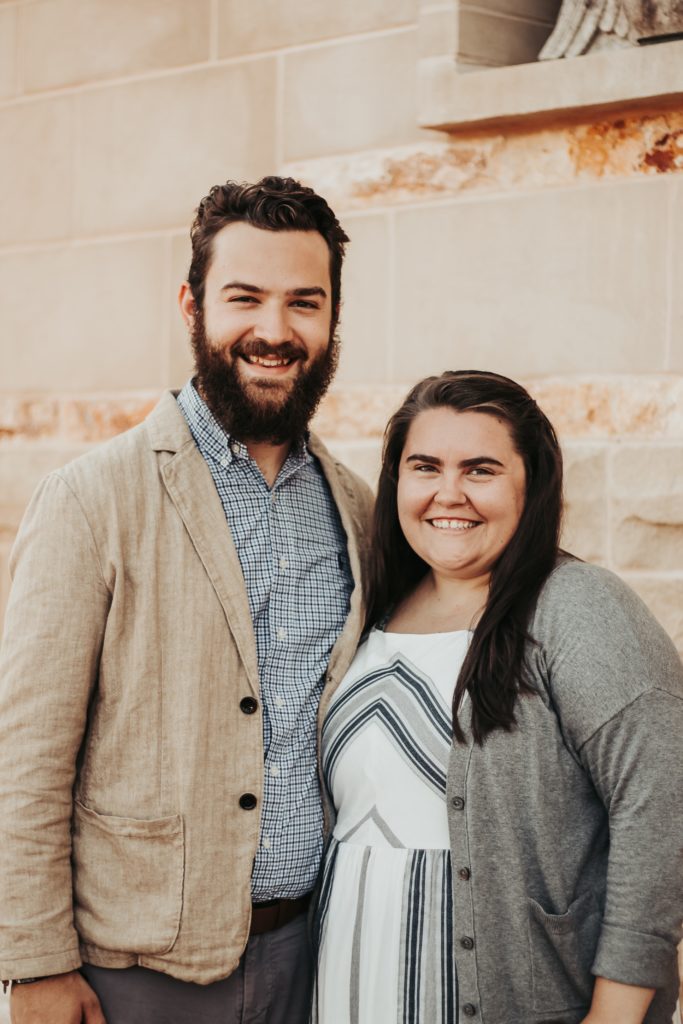
Daniel and Maddie Torres

Daniel Torres: The culture of excellence and virtue at Belmont Abbey prepared me not only for my call to ministry in evangelization, but also for the call to holiness through my vocation to marriage. My wife, Maddie, and I met freshman year and dated all throughout college. It was the foundation of authentic friendship established at the Abbey that helped Maddie and I have a strong community and witness to selfless love.

I always knew that I wanted to work in ministry, even before coming to Belmont Abbey.  However, I didn’t realize how much of an impact the faculty, staff and administration would have on that desire for ministry and sharing my faith. I received profound intellectual formation from my teachers in theology, providing me the opportunity to understand the significance of the truth of the Catholic faith.

The guidance and support of FOCUS missionaries at the Abbey probably had the greatest personal influence on my life. They instilled within me a deep awareness of the poverty of isolation and loneliness in today’s society. The only answer to that poverty is the love and mercy Jesus has to offer.

Newman Society: Why do you think a strong Catholic education is good preparation for a missionary?

Daniel Torres: I firmly believe that a strong Catholic education can prepare one to engage the world with truth, goodness and beauty. I was challenged by my teachers and peers to tackle tough topics head on and enter into dialogue. The Catholic worldview and values I received have been invaluable in my missionary efforts. The Catholic college campus is the perfect environment for peer-based ministry, which helps make Jesus come alive with students. 

Catholic education that is authentic, alive and abundant can be a lifechanging experience. It allows you to become the best person you can be, because you are surrounded by virtuous people who help reveal to you who you are. The whole process of holiness is recognizing the truth of who you are, but striving for the truth of who you’re meant to be. It is possible—and the best opportunity for that is found in Catholic education.

Scattered Catholic College Students Forge Ahead with Prayer

Many faithful Catholic colleges are taking practical steps to help curb the spread of the coronavirus, such as sending students home and switching to online-only courses. But although students are now scattered across the country, many are finding ways to join together in prayer with college leaders, faculty and staff to seek God’s help for those in need.

At Ave Maria University in Ave Maria, Florida, President Christopher Ice — whose planned inauguration later this month has been postponed — has asked his students to “double down” on “prayers, fasting, and sacrifices.”

Students involved with the Mary and Mercy Center just across the street from the University are doing just that. The students are organizing a 54-day Divine Mercy Chaplet novena for an end to the virus and for the “souls of the dying, healing of the sick, the return of souls to the Church.” The novena begins on March 22 and ends on May 14, the feast of St. Corona, patron saint of pandemics.

“Prayer can never be our only response to a problem, but we should never leave it out, either,” says President Stephen Minnis of Benedictine College in Atchison, Kansas, who asked the college community to join him in praying a novena to Our Lady of Monte Berico, who under this title ended a plague in the 1400s.

“I thought now would be a good time to take a breath and do what we as a community do best — call upon Our Lady’s intercession for a swift end to the spread of the virus and for her maternal protection for all,” he continued.

In addition, on Thursday he announced a “Memorare Army,” inviting each member of the Benedictine College community to say the “Memorare” prayer to Mary, Mother of God, 100 times over the next 10 days.

A beautiful Rosary procession was held at Thomas Aquinas College in Northfield, Massachusetts, on March 12, before students were sent home. Altar servers carried a statue of Our Lady across campus to pray for an end to the virus.

In Front Royal, Virginia, the president of Christendom College is asking for prayers to be entrusted to “Jesus Christ through the intercession of Our Blessed Mother.” Dr. Timothy O’Donnell is encouraging students during this “challenging time” to ask for “insight in how we can best act for His greater glory even now.”

“So often throughout history, Christian witness in times of trial moved others to embrace the faith,” Dr. O’Donnell told his community. “What a powerful message God can convey through us if we let Him, showing others our faith in a life after this earthly existence, and our hope in Our Savior who bears our suffering and sin to make possible our eternal happiness.”

The friars at Franciscan University of Steubenville, Ohio, are offering a private Mass every day for an end to the coronavirus. “I would like to invite everybody to pray that God does a mighty work,” says Father Dave Pivonka, president of the University, in a video message to students. “Heavenly father, confound and amaze the scientists by defeating this virus by your power and by your grace.”

Public participation in the Masses on many college campuses has come to a halt, such as at the University of Mary in Bismarck, North Dakota, where Mass on campus is the longest standing tradition extending back to the University’s founding in 1959. A number of colleges, including Belmont Abbey College in Belmont, North Carolina, have begun livestreaming Mass on Facebook and other platforms.

Prayer is certainly needed during this challenging time. President John Garvey of The Catholic University of America in Washington, D.C., has tested positive for COVID-19 and is in quarantine, although he is no longer showing symptoms. Please keep this devoted leader of faithful Catholic education in your prayers.

Catholic college presidents are rightly making tough choices to ensure the safety of students and others in the country. Even more admirable, these faithful leaders are turning to Heaven, recognizing that God triumphs over any challenge.

This article first appeared at The National Catholic Register.

Children’s Author Inspired by Faithful Catholic College

Catholic families are always looking for beautiful Catholic books for children. An alumna of a faithful Catholic college is giving families more timeless options.

Maura Roan McKeegan says that her education in the theology graduate program at Franciscan University of Steubenville, Ohio, inspired her to become an author. Now she’s published several Catholic children’s books as a fruit of her experience in the Franciscan University community, including St. Conrad and the Wildfire, just recently released.

The Cardinal Newman Society is grateful to McKeegan for sharing about the impact of her faithful Catholic education on her life and work, as a part of our “Profiles in Faithful Catholic Education” series.

Newman Society: Why did you choose to attend Franciscan University of Steubenville? What impact did the University have on you?

Maura Roan McKeegan: When I was a young adult—after I graduated from a state university—I attended a summer conference at Franciscan University. I loved it so much that I went back the next year, and the next. I began to daydream of going there to study full-time. I wanted to know more about God, and I couldn’t think of a better place to learn. Franciscan had changed my life so much in three weekends; I could only imagine what three years there would do.

At first, it felt like an impossible dream. I was a classroom teacher and didn’t know how I could leave my job. But soon, God showed me that He was calling me to go to graduate school at Franciscan. I moved to Steubenville to pursue a master’s degree in theology, and Franciscan became a second home to me. The material I studied was so beautiful that it sometimes made me cry. The classes I took, books I read, and people I met helped me grow exponentially in the way I understood and lived my faith.

Eighteen years later, I am still here with my husband, raising our children in Steubenville, and marveling at the way God used three weekends to give me a gift that would last a lifetime.

Newman Society: How has your education at Franciscan University influenced your work as an author?

Maura Roan McKeegan: My education at Franciscan University inspired me to become an author. I remember sitting in Dr. Scott Hahn’s class and listening to him talk about typology—how Adam, Moses, and Jonah prefigured Christ; how Noah’s Ark prefigured baptism; how the Ark of the Covenant prefigured Mary. It was all new to me. I had just spent five years as a classroom teacher, and I thought to myself, “Children would be fascinated by this!”

I had the idea of writing a series of picture books that placed Old and New Testament stories side by side, so that children could see the connections. The idea stayed in my head for ten years, until I finally realized that God was calling me to write the series. Now, through Emmaus Road Publishing, I’ve written three books in that series, with a fourth currently being illustrated.

My newest book, St. Conrad and the Wildfire, is separate from the Old and New series. All of these books are the fruit of my time at Franciscan University, both as a student and as a member of the Franciscan family.

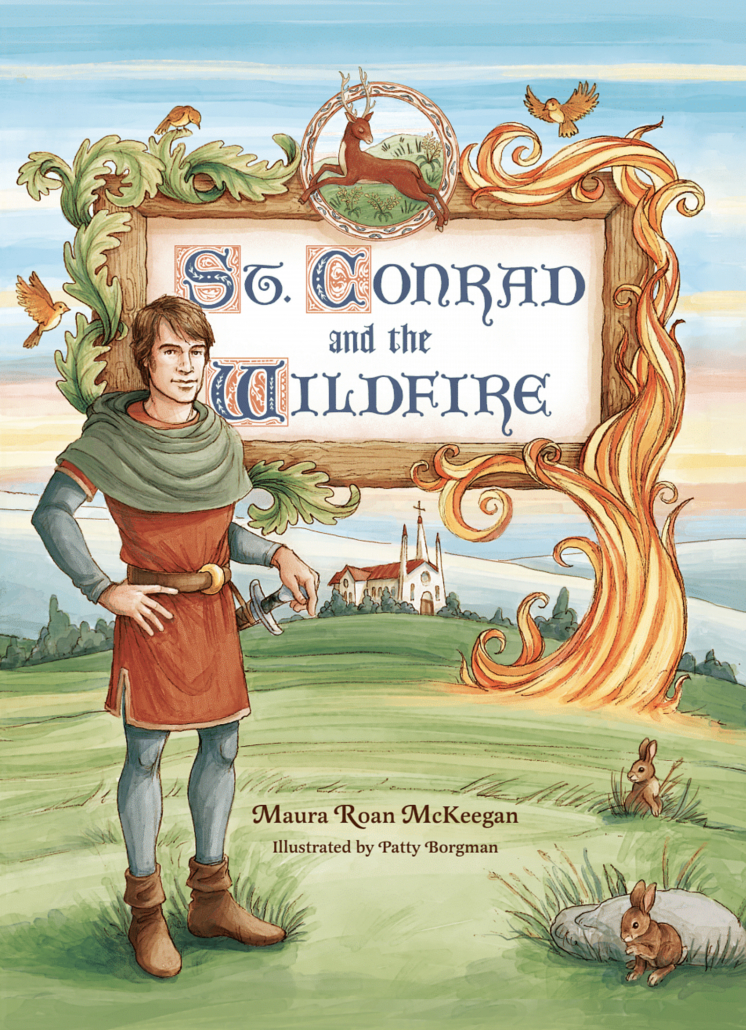
St. Conrad and the Wildfire book cover

Newman Society: Can you tell us about your recently released book for children, St. Conrad and the Wildfire?

Maura Roan McKeegan: About five years ago, I learned about St. Conrad for the first time and was immediately captivated by his story. He was a medieval nobleman who went hunting one day and accidentally set a forest on fire. He didn’t tell anyone the truth about what happened until an innocent peasant was blamed and sentenced to death, and only Conrad’s confession could save him. The course of events that began with his errors eventually led Conrad to become a saint.

St. Conrad’s story struck me as perfect for a picture book. With medieval nobles, a castle, hunting, fire, false accusation, a near execution and the challenge of telling the truth in the face of danger, it had all the elements of an exciting and enduring tale. I also loved how it showed that imperfect people can become saints—that our mistakes can become paths to grace. As a person who makes a lot of mistakes, I found that message consoling.

Newman Society: Why do you think beautiful and well-written Catholic books for children are important?    

Maura Roan McKeegan: Picture books are my hobby and my passion. I love the way they unite generations, when young and old cuddle up together and delight in stories that capture hearts through words and pictures. Beautiful and well-written Catholic picture books give us a way to follow what Jesus says when he tells us to “become like little children” in Matthew 18:3. When we sit with children and read aloud together, we build bonds of love in a world of childlike simplicity that children will remember long after they are grown. Beautiful picture books awaken lifelong connections between love, spiritual childhood and faith.

CNS Joins Amicus Brief Upholding Ministerial Exception – InterVarsity Chirstian Fellowship v U of Iowa, 8th Circuit

Click here to read.

Students Learn Science, Ethics at Franciscan University

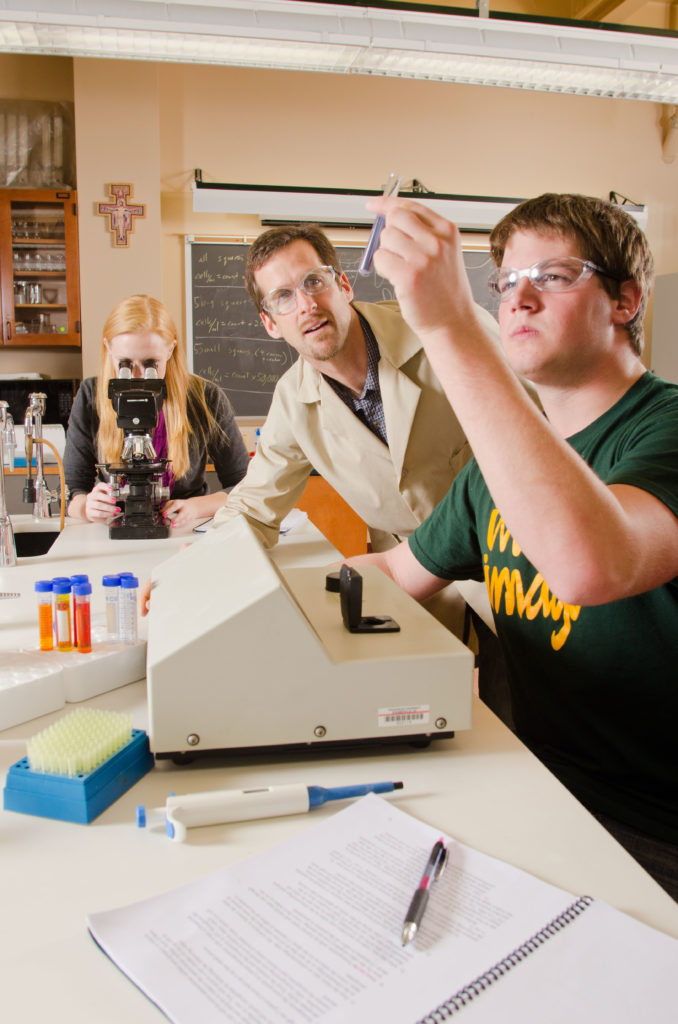
Studying the sciences at a faithful Catholic college, like Franciscan University of Steubenville in Steubenville, Ohio, prepares students for their careers and for considering the moral dimension of their work. Students are given “tools to work through ethical decisions guided by the light of Truth,” says Dr. Dan Kuebler, dean of the natural and applied science programs at Franciscan University.

Dr. Kuebler believes Franciscan University graduates can make an impact through their witness in healthcare professions and help “rebuild a culture of life.” The Newman Society recently asked Dr. Kuebler to discuss what’s different about studying the sciences at Franciscan University, and about plans for future science offerings.

Newman Society: How does Franciscan University of Steubenville teach the sciences from an authentically Catholic perspective?

Dr. Kuebler: All of our students take an integrated core curriculum that enculturates them in the Catholic Intellectual Tradition and, in particular, the theological and philosophical tradition of the Church. What they learn in these courses allows them to think critically about and fully engage with the learning experiences they have within the science programs.

Within the biology curriculum there are many issues that are discussed from a scientific perspective such as human sexual behavior, in vitro fertilization, cloning, contraception, etc. Students are not only taught about the latest science regarding these topics, but they also engage with their science faculty regarding the ethical and moral dimensions of these topics. Because they have been given the framework by which to engage these issues in their philosophy and theology classes, they are able to articulate and then ultimately defend the Catholic positions on these matters, positions that uphold the inherent dignity of human life.

If we fail to help our students achieve this integration, then we are not preparing them to live out their vocation as Catholic health care providers and scientists. We are not preparing them to be salt and light to a world sorely in need of a witness to the Truth.

Photo via Franciscan University of Steubenville

Newman Society: Last fall, Franciscan University unveiled a new biochemistry degree. Can you tell us about this exciting development, and other plans for science offerings at Franciscan?

Dr. Kuebler: The new biochemistry degree offers another science option for our students, particularly those interested in medical school and graduate school. The program takes the best of our existing biology and chemistry faculty along with new biochemistry faculty to produce a program that gets students into the lab doing research early on in the program.

In addition to the biochemistry degree, we are planning on launching four-year engineering degrees in Software Engineering and Mechanical Engineering over the next two and a half years. Currently we have partnership programs in which students spend two to three years on campus taking pre-engineering courses and then finish their engineering degree at a partner school.

While students in the program succeed academically at the partner schools, they do not want to leave the Franciscan academic community given the robust integration of faith, reason and community that exists here between our students, faculty and staff. Providing a high-quality fully accredited Bachelor of Science in engineering here on campus, we will be meeting the needs of these students as well as many other potential Catholic young women and men whom God has called to this field.

We are also expanding the cybersecurity course offerings within our computer science program with the aim of adding a certificate in cybersecurity to allow our students to have the preparation and hands-on experience to enter this burgeoning field.

Newman Society: Why do you think receiving a faithful Catholic education is crucial for future doctors, scientists and healthcare professionals?

Dr. Kuebler: There are so many ethical issues that scientific researchers and healthcare professionals face in the workplace. Too often, a utilitarian ethos drives medical decisions from end-of-life care to fertility treatments and leads to care and decisions that undermine the inherent dignity of human life.

By being immersed in the Catholic intellectual tradition and all its beauty and wisdom, our students have the tools to work through ethical decisions guided by the light of Truth. Their witness and ability to influence other healthcare professionals is the only manner in which we can hope to rebuild a culture of life that respects human life at all stages.

Newman Society: Franciscan is also well-known for its strong theology programs. How do the sciences and theology studies work together? Do many science students also minor in theology?

Dr. Kuebler: Our students must take three theology courses and three philosophy courses to graduate. Many students choose to take just three additional courses to minor in one of these two disciplines. Most of the science programs have five or six free electives, so it’s easy for students to do so.

This type of preparation only helps our students better articulate the beauty of the faith and navigate the ethical minefield of modern science and medicine in such a way as they bear witness to the Truth.

We host many interdisciplinary talks about topics such as gender ideology, fertility treatments, genetic modification and transhumanism so that students can hear from experts in both science, theology and philosophy on these topics. This type of integrated approach is essential for true learning.

Catholic Colleges Refuse to Disintegrate Faith from Science, Says Newman President

Our Sunday Visitor recently published the following article online, featuring Newman Society President Patrick Reilly:

There is a false notion that religion is an impediment to science. It is a contention that students in the sciences of biology will likely confront in their field. Educators at committed Catholic colleges explain that faith and science are in harmony with one another, and it is part of their mission to help students understand that.

Good Catholic institutions integrate these two bodies of knowledge since God is the author of both, and faith united with science provides moral safeguards. In the field of biology, however, where creating human life in petri dishes and changing the DNA of a human embryo are possible, human beings mistakenly think that they can play God.

“It’s not really a matter of integrating faith with science, it’s refusing to follow the atheist approach of disintegrating faith from science,” according to Patrick Reilly, president and founder of The Cardinal Newman Society, which promotes faithful Catholic education and publishes the annual Newman Guide to Choosing a Catholic College. “A Catholic school or college should be eager to address obvious and fundamental questions of where things come from, who designed such amazingly complex systems, what are the purposes of things, and what is man’s role in nature. Science, like every discipline, is better understood and appreciated with the insights of Christianity.”

Continue reading at Our Sunday Visitor…

Catholic School Athletics Must Be Truthful

Gender ideology has created huge inequities in the world of sports, with men competing on women’s teams and sometimes taking top honors away from outstanding female athletes.

Add to this many other controversies in sports, including players refusing to respect the national anthem, cheating and betting scandals, sexual abuse and harassment, and more.

Catholics are forced to ask some important questions: Is there a Catholic approach to athletics, especially in Catholic schools and colleges? Should we simply embrace the norms of secular schools and athletic associations in order to have opportunities to compete against them?

The Church has not shied away from these questions, but rather has been outspoken about the role of sports. Pope St. John Paul II especially focused on athletics in many homilies, messages and speeches.

“Sport… is an activity that involves more than the movement of the body; it demands the use of intelligence and the disciplining of the will,” he told athletes in 1987.

“It reveals, in other words, the wonderful structure of the human person created by God as spiritual being, a unity of body and spirit,” he said.

What a wonderful message! But sadly today, “body” and “spirit” are being divided in sport because of gender ideology.

Some girls have had enough of it, and Alliance Defending Freedom is representing them in a lawsuit against a Connecticut athletic conference that allows biological boys to defeat biological girls in high school track competitions. Catholic schools and colleges, too, should stand their ground and uphold truth.

“Given the incompatibility of gender ideology and a Catholic worldview, Catholic educational institutions cannot simply look the other way or surrender their vision of man and reality. Too much is at stake,” writes Dr. Dan Guernsey, senior fellow of The Cardinal Newman Society, in a draft set of standards for Catholic school and college athletics.

The standards are being circulated among experts in Catholic education, sports and theology to find common ground and help educators avoid the errors of their secular counterparts.

Athletics can be important to student development, explains Guernsey. “It can affect their understanding of themselves and their relationship with God in profound ways.”

According to the Vatican, the mission of Catholic education is about the “integral formation of the human person.” Athletics can support this mission by helping students “develop virtue and harmonize mind, body and will,” Guernsey writes.

But respecting the sex of athletes, he argues, is necessary to ensure player safety, fair play and social justice. It’s crucial for Catholic schools and colleges to develop clear position statements and policies to ensure that “athletics is not coopted to work against the mission of Catholic education.”

Ultimately, sports at Catholic schools and colleges should bear witness to the Truth. And in a culture that’s increasingly relativistic, Catholic athletics must go against the tide.

This article first appeared at The National Catholic Register.