
Q&A: Walking in the Footsteps of Saints at The Catholic University of America

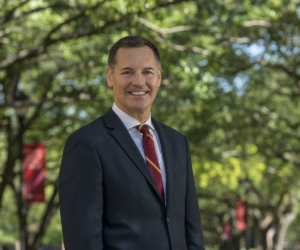
As the only Catholic university in America founded by the U.S. bishops, The Catholic University of America boasts a rich Catholic tradition going back to the late 1800s from its campus in Washington D.C. This tradition has provided the school with one of the most unique legacies for an American Catholic institution of higher education: a legacy filled with saints. The Cardinal Newman Society recently asked Catholic University President John Garvey to discuss the many saints and holy people who have walked the halls and sidewalks of “bishop’s university.”

Newman Society: The Catholic University of America is known as the “bishops’ university,” since it is the Church’s national university in the U.S., but not many people know that canonized saints and prominent Church leaders have visited and studied there. Who are some of these saints, and what stories stand out from their time on campus?

President Garvey: For nearly 25 years beginning in 1926, Venerable Fulton Sheen (then Monsignor Sheen) taught in room 112 in McMahon Hall, prayed daily in Caldwell Chapel, and studied in Mullen Library. During those years, The Tower, Catholic University’s student newspaper, published more than 180 articles about Monsignor Sheen — his speeches, debates, books, and radio programs. Today, there is a plaque at room 112 to commemorate those years and the University hosts a website about the life of Fulton Sheen and his cause for sainthood.

Catholic University awarded Mother Teresa her first honorary degree in 1971, eight years before she would receive the Nobel Peace Prize. Thousands of papers and records related to her are housed in our University Archives. Students remember our connection to this saint every fall when we come out by the hundreds to help our surrounding communities on the University’s Annual Mother Teresa Day of Service, which is this coming Sunday.

Sister Thea Bowman, whose cause for sainthood has been endorsed by the U.S. bishops, received her master’s degree and Ph.D. at Catholic University. She was an educator, trailblazer, and advocate for the Black Catholic experience. When we formed a committee last year to explore and recommend ways in which the University can promote racial justice on campus, we naturally named it the Sister Thea Bowman Committee, and a road is named for her on our campus.

Servant of God Emil Kapaun, a priest from the Diocese of Wichita and a candidate for sainthood, received a master’s degree from Catholic University in 1948. He was captured by the North Koreans in 1950 while serving as a U.S. Army chaplain, and was killed while a prisoner of war. President Obama awarded him the Medal of Honor in 2013, and his remains have recently been identified. Later this month a Catholic University representative will be present when they bury his remains in Wichita.

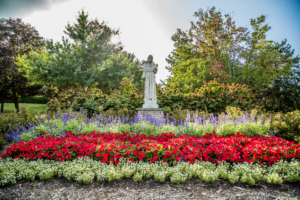
The Knights of Columbus, founded by recently beatified Father Michael McGivney, is a permanent fixture here on campus. Our law school was named the Columbus School of Law after we merged our law school with Columbus University in 1954. In 2008 we named a renovated hall McGivney Hall after the Knights of Columbus generously gave $8 million for the facility’s extensive renovations. We have a statue of Blessed Michael McGivney outside of the hall’s entrance.

Cardinals and bishops frequent our campus, often interacting with students. They celebrate Mass with us and many serve on our Board of Trustees. Our chancellor, Cardinal Wilton Gregory, archbishop of Washington, became the first African American cardinal in November 2020. He is part of our community and an inspiration to many of our students.

Newman Society: Considering the honorary degrees awarded to Saint Teresa of Calcutta, Venerable Fulton Sheen, Saint Katharine Drexel and others, why is it important for the Catholic University of America to hold up exemplars of moral virtue?

President Garvey: The role of Catholic University is not simply to produce scholars, but to produce scholars steeped in the Catholic intellectual tradition. These men and women – saints, blesseds, and servants of God – inspire us to live lives of virtue, founded in our faith and in service to others.

Newman Society: Pope Francis, Pope Saint John Paul II and Pope Benedict XVI have all made historic visits to campus. How did that contribute to students’ experience and their education?

President Garvey joins Catholic University students as they prepare food for those in need at a local community center in Washington, D.C., on the University annual Martin Luther King Jr. Day of Service hosted by campus ministry, 01/20/20 (Photo credit: Patrick G. Ryan, The Catholic University of America)

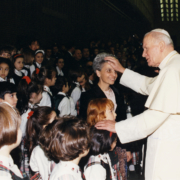
President Garvey: The Catholic University of America is the only university in the country to have been visited by three popes. Pope (now Saint) John Paul II visited our campus in 1979. We hosted Pope Benedict in 2008 when he delivered an address on Catholic education at the Edward J. Pryzbyla University Center. On Sept. 23, 2015, Pope Francis came to our campus, and, for me, it was an honor to be part of the experience as University President. On that day the Holy Father celebrated the canonization Mass of Junípero Serra from the East Portico of the Basilica of the National Shrine of the Immaculate Conception overlooking our campus where more than 25,000 worshippers gathered. Among them were hundreds of our students, many of whom would later tell me it was a life-changing moment.

That visit to our campus was historic for many reasons. It was the first canonization to take place on U.S. soil. It was the first Mass Pope Francis celebrated in the United States, and it was in fact his first visit to the U.S. in his life. For those of us who attended the Mass, most especially our students, it was a day we will never forget.

Our involvement with the pope’s visit went beyond the Mass. During the summer before Pope Francis’s visit, the Archdiocese of Washington and Catholic Charities launched the #WalkwithFrancis campaign to encourage D.C.-area residents to follow the example of Pope Francis, pledging service and prayer in the weeks leading up to his visit. At the University we embraced the theme, which we wore on bracelets, with Campus Ministry-sponsored service events and a series of educational programs. Our goal as a University was to ensure our community had the opportunity to be part of the historic visit in meaningful and memorable ways.

For the visits by both Pope Benedict and Pope Francis, students in our School of Architecture competed to design the liturgical furniture used for papal Masses. The altars continue in use today, at the Basilica and Washington’s Saint John Paul II Seminary.

Newman Society: Catholic education should be forming every student for sainthood. How is Catholic University preparing the next generation of saints and leaders for our Church and world?

President Garvey: We encourage our students to love both God and neighbor, and to do so in that order. That’s why I tell freshmen at orientation to not forget to pray. I hope they’ll study hard at Catholic University and make good friends. These are important things. But they’re not the last things. Prayer helps our students balance all the demands of university life, and helps them keep their priorities in view. It also reminds them why they are here — not just here at The Catholic University of America, but here on earth. College can be stressful at times. God’s abiding peace is the best stress reliever. So I encourage them to take advantage of the many opportunities to pray with others at Catholic University.

We want our students to have a vibrant spiritual life, so we provide the sacraments on campus often. Every year I conclude orientation with a Public Service Announcement to the incoming class that includes all Mass and confession times, just so they know how easy it is to keep up their spiritual life.

And from our commitment to love God there naturally flows a deep commitment to serve our neighbor. We begin every fall semester with our Annual Mother Teresa Day of Service and at the start of each spring semester, our community turns out for the Martin Luther King Jr. Day of Service. On nearly every day of our academic year, students can participate in service, from our homeless food runs that take them into the city with meals to after-school reading programs to visits to senior housing facilities. Domestic and international service-learning trips are available every spring break and summer. The NCAA and the Catholic Volunteer Network have recognized Catholic University students for national leadership in giving back to the community.

Some Hard Truths About Secular Colleges

R. Reno made waves a few months ago, because of his frank rejection of “elite” secular universities. Let’s hope Catholic educators were paying attention.

Reno is editor of First Things magazine, which caters to a generally highbrow readership. Before teaching at Jesuit, but largely secularized, Creighton University, he graduated from the prestigious Haverford College and earned his Ph.D. at Yale.

Still, Reno no longer recruits Ivy League graduates for his staff.

“I don’t want to hire someone who makes inflammatory accusations at the drop of a hat,” he writes, responding to the increasingly hostile “cancel culture” at Ivy League universities and most other secular colleges. He also doesn’t want to hire graduates who have become “well-practiced in remaining silent when it costs something to speak up” against prevailing campus ideologies.

“I have no doubt that Ivy League universities attract smart, talented, and ambitious kids,” Reno acknowledges. “But do these institutions add value? My answer is increasingly negative. Dysfunctional kids are coddled and encouraged to nurture grievances, while normal kids are attacked and educationally abused.”

Most Catholic college students attend secular colleges or largely secularized Catholic colleges, where the anti-reason “cancel culture” threatens anyone who espouses Catholic teaching or celebrates Western culture. Shouldn’t the Church be doing something about these dangers?

Continue reading at The Catholic Thing…

A Pastor Saves His Flock by Catholic Education

In Northern Virginia, where critical race theory, gender ideology, and emptied classrooms because of COVID-19 have sparked protests by angry parents of public-school students, a parish priest is taking up the legendary Archbishop “Dagger John” Hughes’ mission of helping Catholic children get out of public schools by every means possible.

Archbishop Hughes founded the Catholic school system in New York City in the mid-1800s and famously declared, “We shall have to build the schoolhouse first and the church afterward. In our age, the question of education is the question of the Church.”

Faithful Catholic education is no less urgently needed today. So, when the pandemic hit last year, Fr. John De Celles of St. Raymond of Peñafort Parish in Springfield, Virginia, instituted a one-time $2,000 scholarship for each child in his parish who switched from a public elementary or secondary school to a Catholic parochial or lay-run school.

This year, Fr. De Celles has renewed that offer again, thanks to the generosity of parishioners. He also doubled the parish’s annual, renewable scholarships to $1,000 for students in Catholic grade schools and $2,000 for students in Catholic high schools. And on a case-by-case basis, St. Raymond’s offers additional financial aid to families in need and helps cover the direct educational costs of families who homeschool.

Continue reading at Crisis Magazine…

Newman Society President Discusses Ministerial Exception on Drew Mariani Relevant Radio Show

Patrick Reilly, president and founder of The Cardinal Newman Society, joined the Drew Mariani Show on Relevant Radio Tuesday to discuss an appeal to the United States Supreme Court regarding the “ministerial exception” and its protection for religious colleges. A recording is available here.

The guest host Ed Morrissey noted that the Newman Society had co-filed an amicus brief to the Supreme Court requesting that it block the Massachusetts Superior Court’s narrow reading of the ministerial exception, thereby allowing a professor of social work to sue Gordon College for denying her a  promotion.

The ministerial exception is a First Amendment principle that bars courts from interfering with personnel decisions concerning employees who have substantial religious duties, including religious instruction and formation. The Supreme Court upheld the exception for a school teacher in Hosanna Tabor Evangelical Lutheran Church and School v. EEOC (2012) and reaffirmed the exception for religion teachers at Catholic schools in Our Lady of Guadalupe School v. Morrissey-Berru last summer.

“In both cases they made it very clear that teaching the faith is about as ministerial as it gets, that the institutions are protected from lawsuits based on discrimination,” Reilly explained.

The Gordon College case has special importance for the ministerial exception, Reilly said, “because it involves a college, which the Supreme Court has not yet considered, and it also involves someone who is not teaching theology, but is teaching social work,” Reilly said.  “At Gordon College they make very clear that every professor must be teaching the faith as part of their course work [and] they should be protected as part of the ministerial exception.”

The Gordon College case is yet another attempt to “rein in the ministerial exception,” Reilly said, citing a recent case in which a parish employee sued the Archdiocese of Chicago, claiming that the “ministerial exception only applies to hiring and firing decisions and not other employment decisions” including claims of a hostile work environment. The Newman Society petitioned the Seventh Circuit Court of Appeals to support the First Amendment rights of religious employers, which the court did in July.

Host Morrissey noted the importance of these rulings and the ministerial exception, pointing out that “the point of the church teaching function is to promote church teaching.”

“To have the state step into those decisions, certainly in Hosanna Tabor, the Supreme Court found it to be almost an explicit intrusion into religious faith and religious exercise,” he said.

Newman Society Urges Supreme Court to Apply Ministerial Exception to Religious Colleges

On Thursday, The Cardinal Newman Society, which promotes and defends faithful Catholic education, with the International Alliance for Christian Education and the Association for Biblical Higher Education, urged the United States Supreme Court to overturn a Massachusetts high court ruling that would severely restrict the ministerial exception for religious higher education.

The amicus brief was authored and filed on Sept. 2 by Sharon Rose and Samuel Diehl of the Washington, D.C.-based Cross Castle PLLC.

In March, the Supreme Judicial Court of Massachusetts ruled in Gordon College v. DeWeese-Boyd that Gordon College is indeed a Christian college and its professors are required to teach and uphold Christian principles, but the Court nevertheless allowed a dissenting social work professor to proceed with a lawsuit against the college for refusing to promote her. Court interference in religious hiring practices is a violation of the First Amendment’s Free Exercise Clause and the ministerial exception, according to the U.S. Supreme Court’s ruling last year in Our Lady of Guadalupe School v. Morrissey-Beru.

“Catholic and other religious colleges deserve the same First Amendment protections that have been upheld for religious schools,” said Patrick Reilly, President of The Cardinal Newman Society. “The Supreme Court last year clearly upheld the ministerial exception with regard to a schoolteacher hired specifically to teach religion classes. We now call on the Court to make clear that the ministerial exception applies to professors, regardless of their discipline, at institutions where religious faith informs all that is taught and employees are required to be witnesses to religious beliefs.”

As argued in the brief, “Gordon is entitled to define its faith and determine how that faith is carried out in matters of internal government and employment, not individual faculty members. The standard the Massachusetts Court applied fundamentally threatens Gordon’s and other religious institutions’ ability to accomplish their missions and to maintain their pervasively religious character.”

CNS Joins Amicus Brief Upholding Ministerial Exception – Gordon College v DeWeese-Boyd, U.S. Supreme Court

The Cardinal Newman Society joined an amicus brief at the United States Supreme Court urging the court to overturn a Massachusetts high court ruling that would severely restrict the ministerial exception for religious higher education.

Archdiocese of Indianapolis Fights for the Right to Have Faithful Employees

The Archdiocese of Indianapolis has been fighting several battles for the protection of Catholic education, and last month’s federal court victory was an especially exciting step forward.

A federal district court in Indiana ruled that the Archdiocese and its Roncalli Catholic High School have the First Amendment right to uphold moral standards — not only for religion teachers, as the U.S. Supreme Court affirmed last summer in its Our Lady of Guadalupe School ruling, but also for other employees who aid in the Christian formation of students.

“Catholic schools focus on the complete person, made in God’s image and likeness, not just on the mind or on a subject matter,” wrote my colleague Dr. Dan Guernsey last year. “Learning and formation happen concurrently. They are entwined.”

His position paper, “All Employees Matter in the Mission of Catholic Education,” made the important argument that every employee of a Catholic school is important to its mission of educating and forming young people in the Catholic faith. Although last year’s Supreme Court ruling focused on a Catholic school religion teacher, the ministerial exception — which prevents federal courts from interfering in employment decisions that substantially involve religious duties — ought to also protect a faithfully Catholic school or college with regard to teachers of all subjects as well as other employees and administrators.

The Roncalli case centers on a school guidance counselor who worked closely with students. Counseling is a duty that relates just as strongly to the Christian formation of students as teaching, and Catholic school counselors must model the moral teachings of the Church as an example to students. Sadly, the Roncalli counselor entered into a same-sex marriage and was dismissed.

Roncalli and the Archdiocese of Indianapolis did not shy away from the Church’s moral beliefs in their employee policies and in their legal defense. By establishing a clear moral expectation for employees, the school has a strong claim to First Amendment protections under the Free Exercise Clause. More important, it ensures that the good of its students is first and foremost protected.

Much More to Come

The struggle is not over for Archbishop Charles Thompson and his Indianapolis schools, but the outlook is brighter.

Although the guidance counselor is appealing the Roncalli decision to the 7th Circuit Court of Appeals, that is the same court that in July dismissed a lawsuit by a Chicago parish music director who also entered into a same-sex union. The court invoked the ministerial exception, rejecting the plaintiff’s argument that the exception covers only complaints about hiring and firing decisions and not claims of a hostile work environment.

“A Catholic school has freedom to hire and fire ministers based on alignment with the Catholic Church’s religious teachings about sex, sexual orientation, and marriage,” the Newman Society noted in an amicus brief in the case.

“But if a Catholic school minister engages in a course of conduct that violates the Catholic Church’s teachings, and the school persistently communicates that the minister has strayed from the school’s moral expectations and should repent,” then the school could have been forced to stand trial had the 7th Circuit agreed to narrow the scope of the ministerial exception.

Another guidance counselor from Roncalli, who was also fired for entering into a same-sex union, is pursuing a separate lawsuit. That case is before the same federal judge who dismissed the similar case last month.

Meanwhile, same-sex partners at two other Indianapolis-area Catholic schools have fought the Archdiocese and its moral standards for school employees. One of them, a teacher who was dismissed from Cathedral Catholic High School in Indianapolis, saw his lawsuit dismissed in Marion County Superior Court in May, but he is appealing the ruling.

His legally married partner still teaches at Brebeuf Jesuit Preparatory School, which refuses to abide by archdiocesan policy. Archbishop Thompson took action in 2019 to declare the school no longer Catholic and forbid Mass in its chapel, but the school appealed to the Vatican, which for two years has failed to provide any resolution.

So there is much more to come, but the rulings this summer reinforce the scope of the ministerial exception and give hope to Catholic educators. Perhaps the most important lesson that can be drawn in the meantime is that Catholic schools and colleges should continue to ensure that employees are committed wholly to the mission of the school and the Church. It’s legally protected and it’s the right thing to do for Catholic families.

Every employee in a Catholic school, from the principal to the gym teacher, is important to the mission of Catholic education. Clear and consistently enforced policies that expect employees to model moral behavior is a key part of leading young people to Christ.

This article first appeared at the National Catholic Register.

Thomas Aquinas College Plans New Leadership, Same Faithful Mission

Once oppressed in Ireland because of his Catholic faith, Dr. Paul O’Reilly is preparing to take the helm at one of America’s most exciting and celebrated Catholic institutions, Thomas Aquinas College.

Current President Dr. Michael McLean will step down at the end of this school year, following the celebration of the college’s 50th anniversary. In 11 years, McLean has successfully strengthened the college despite challenges including wildfires and threats to religious freedom. He led the establishment of a second campus in Massachusetts, providing the same faithfully Catholic, Great Books program that has earned the California institution high marks in secular rankings and the recommendation of The Cardinal Newman Society.

O’Reilly clearly has some big shoes to fill. I recently congratulated him on his selection as the college’s next president, which he says is “a high honor that is quite humbling.”

For O’Reilly, the goals and academic structure at Thomas Aquinas College are pretty much the same today as they were when he attended the college as a student 40 years ago. “I still recognize this college, I still love this college,” O’Reilly says.

But Dr. McLean and his team have made some major advancements, including expanding the Santa Paula, California, campus and quickly establishing a strong foundation in Northfield, Massachusetts.

“It’s a great time to take over,” O’Reilly says. “The college is strong, it’s growing and has expanded to the East Coast. Don’t ask us why we have campuses in California and Massachusetts. That’s God’s plan. We needed to expand, because we had more students applying than we could accept.”

The mission and the vision remain the same, and that’s what O’Reilly wants to maintain: a classical liberal arts education unlike any other in the world, that forms students to appreciate and understand the true, the good and the beautiful.

“We can provide a serious Catholic formation, not just in philosophy and theology but also in various other areas,” O’Reilly says. “To see the impact that we’re having is exciting to me.”

The choice of O’Reilly, an alumnus who has served the college for 30 years as a faculty member and then vice president for advancement, is a great reminder that a college’s impact is only as good as its people and their devotion to its mission. O’Reilly recognizes that fact. He believes that one of the most important aspects of maintaining the vision and the mission of the college is the hiring of good faculty.

“Schools go astray when the faculty are not of one mind of the mission of the college,” he says. “The faculty know what we’re about, and they support it.”

One of O’Reilly’s strongest supporters will be Dr. McLean, who returns to the faculty after formally handing over the presidency.

O’Reilly’s own journey to California started in Northern Ireland, where his family was persecuted for their Catholic faith by Protestant extremists. He and his siblings were adopted by their aunt and uncle in Canada, following the tragic death of his mother in a car accident.

God led him to Thomas Aquinas College, exemplifying the important role that faithful Catholic education can have in a person’s life. I am excited to see how he steers the college into this new chapter of its history. I have great admiration for his predecessor, having observed and worked alongside Dr. McLean on Catholic education issues for the past several years, and I have every reason to expect that Dr. O’Reilly will continue in the same direction.

May God bless both these men for their admirable dedication to forming young people in wisdom and virtue, and may he grant Thomas Aquinas College many more years of providing extraordinary education.

This article first appeared at the National Catholic Register.

Teaching Racial Harmony from Theology of the Body

How should Catholic educators respond to the racial turmoil in recent years? Instead of adopting new materials and programs rooted in critical race theory, the Church already has a treasury of wisdom to draw upon.

I recently spoke about this with my colleague, Dr. Denise Donohue, who seems to be on to something important. She told me Catholic educators should discuss race from the foundation of Christian anthropology and St. John Paul II’s Theology of the Body, with its insights about human dignity and creation — and I think she’s exactly right.

Donohue is vice president for educator resources at the Cardinal Newman Society and has been a leader and teacher at Catholic schools and a university professor. Last year she worked with Dr. Joan Kingsland, a theologian and curriculum and training specialist at Ruah Woods Press, to co-author the “Standards of Christian Anthropology,” which has been enthusiastically welcomed by Catholic education leaders to integrate St. John Paul II’s theology across grade levels. They supplement the Cardinal Newman Society’s Catholic Curriculum Standards for literature, history, math and science, co-authored by Donohue and Dr. Dan Guernsey.

Somewhere within this work are important clues to teaching about race and justice in ways that are appropriate to faithful Catholic education. Hoping to explore the approach further, I put the following questions to Donohue and Kingsland.

Continue reading at Homiletic & Pastoral Review…

Newman Society’s Dan Guernsey Discusses Cancel Culture, Critical Race Theory on ‘Catholic Current’

Preserving the Catholic worldview in Catholic education means rejecting today’s “cancel culture” and refusing to be compromised by critical race theory, explained Dr. Dan Guernsey, Education Policy Editor and Senior Fellow of The Cardinal Newman Society, on “The Catholic Current” show with Father Robert McTeigue, S.J.

The show aired on July 19 on The Station of the Cross radio. The podcast recording of the 50-minute conversation is available on the Station of the Cross website and on Spotify and Apple podcasts.

The discussion covered a wide range of topics related to cancel culture and critical race theory, including defining the two issues, how they fit into social practices today, how they have affected Catholic education and the appropriate response from Catholic educators and parents.

Critical race theory, Guernsey said, “is not about racism.”

“We all agree and have been trying for many years to stop the sin of racism wherever it is found. We’ve all been fighting this for decade. This is not about racism; this is about replacing one worldview with another.”

As Father McTeigue noted, cancel culture and critical race theory “really aren’t compatible with the Catholic worldview.”

“Cancel culture comes in, [because] they have to cancel the existing worldview,” Guernsey said. “The existing Christian worldview that we’re trying to present in Catholic schools, that’s precisely what they’re trying to cancel.”

Guernsey and Dr. Denise Donohue, Vice President for Educator Resources at The Cardinal Newman Society, recently authored a series of resources for educators and parents regarding the dangers of cancel culture and critical race theory when applied to a Catholic education.