CNS Joins Amicus Brief on Constitutional Rights of Religious Colleges – YU Pride v Yeshiva University, N.Y. Supreme Court

The Cardinal Newman Society joined an amicus brief at the New York Supreme Court, urging the court to protect Yeshiva University’s religious freedom to deny recognition to a student club.

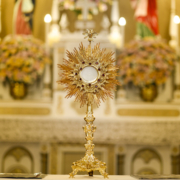
Launching Task Force for Eucharistic Education

In support of the U.S. bishops’ three-year Eucharistic Revival, The Cardinal Newman Society is collaborating with Catholic educators nationwide to launch the Task Force for Eucharistic Education—an initiative to help solicit, identify, and promote inspiring efforts by Catholic schools, homeschools, colleges, and individuals to help revive:

  • Eucharistic literacy – teaching young people the truth of the Real Presence in the Eucharist
  • Eucharistic liturgy – improving music, prayer, and reverence in school and college liturgies
  • Eucharistic devotion – increasing prayer and adoration among young people
  • Eucharistic living – helping students live according to the reality of Christ within them

The project was announced today at Sacra Liturgia, an international conference on the liturgy that was supported in part by The Cardinal Newman Society and featured Society President Patrick Reilly’s public interview with Archbishop Salvatore Cordileone of San Francisco on the renewal of faithful Catholic education. Several prominent Catholics and leaders of national education associations have agreed to help promote the Task Force and serve on its steering committee (see list below).

“Catholic education is the Church’s primary means of evangelization, and it is key to the success of the Eucharistic Revival,” said Patrick Reilly, president of The Cardinal Newman Society. “Americans’ lack of belief in the Real Presence is a crisis of education, not dissent. Young Catholics are confused and need faithful Catholic education, not just flashy events and youth programs amid a culture that disdains religious belief and morals.”

The Task Force invites educators, parents, and students to sign up at EucharisticEducation.org and identify projects including academic conferences, research, publications, formative student programs, liturgies, prayer, and more—anything that strengthens understanding and devotion to the Eucharist within Catholic schools, homeschools, or colleges.

The Cardinal Newman Society will highlight and promote Task Force members and their projects through the Society’s magazine Our Catholic Mission—which is mailed to Catholic education leaders and bishops nationwide—and in Catholic media.

Already the Task Force includes many of America’s most faithful Catholic schools and colleges among its inaugural members. “We hope for an explosion of inspiring projects that help renew faithful Catholic education and form a new generation of young people deeply in love with Jesus Christ,” said Reilly.

For more information on The Cardinal Newman Society and how you can join the Task Force, go to EucharisticEducation.org


Steering Committee of Task Force for Eucharistic Education 
  • Mary Pat Donoghue, Executive Director, Secretariat for Catholic Education, U.S. Conference of Catholic Bishops
  • Deacon Keith Fournier, Dean, Catholic Online School
  • Charlie McKinney, President, Sophia Institute Press
  • Father David Pivonka, T.O.R., President, Franciscan University of Steubenville
  • Dr. Robert Royal, President, Faith and Reason Institute
  • Dr. Michael St. Pierre, Executive Director, Catholic Campus Ministry Association
  • Patrick Reilly, President, The Cardinal Newman Society
  • Monsignor James Shea, President, University of Mary
  • Lincoln Snyder, President, National Catholic Educational Association
  • Father Peter Stravinskas, President, Catholic Education Foundation
  • sister Cecilia Anne Wanner, O.P., President, Aquinas College (Nashville)
Inaugural Institutional Members of Task Force for Eucharistic Education 
  •  Academy of Our Lady (Marrero, La.)
  • Ave Maria University (Ave Maria, Fla.)
  • Beckman Catholic High School (Dyersville, Iowa)
  • Belmont Abbey College (Belmont, N.C.)
  • Benedictine College (Atchison, Kan.)
  • Christendom College (Front Royal, Va.)
  • Father Gabriel Richard High School (Ann Arbor, Mich.)
  • Holy Apostles College & Seminary (Cromwell, Conn.)
  • Holy Child Catholic School (Tijeras, N.M.)
  • Holy Rosary Academy (Anchorage, Alaska)
  • John Paul the Great Catholic University (Escondido, Calif.)
  • Magdalen College of the Liberal Arts (Warner, N.H.)
  • Maur Hill-Mount Academy (Atchison, Kan.)
  • Our Lady of the Sacred Heart School Coraopolis, Pa.)
  • Regina Pacis Academy (Norwalk, Conn.)
  • Rhodora Donahue Academy of Ave Maria (Ave Maria, Fla.)
  • Seton School (Manassas, Va.)
  • St. John Vianney High School (St. Louis, Mo.)
  • St. Theresa Catholic School (Sugar Land, Tex.)
  • Thomas More College of Liberal Arts (Merrimack, N.H.)
  • University of Dallas (Irving, Tex.)
  • University of St. Thomas (Houston, Tex.)
  • Walsh University (North Canton, Ohio)
  • Wyoming Catholic College (Lander, Wyo.)

CNS Joins Amicus Brief on Equal Treatment of Religious Groups – Fellowship of Christian Athletes v San Jose Unified School District, 9th Circuit

The Cardinal Newman Society joined an amicus brief at the 9th Circuit Court of Appeals, opposing the exclusion of a religious organization from equal treatment under the law, simply because it has religious standards for its leaders and members.

CNS Joins Amicus Brief Upholding Ministerial Exception – Faith Bible Chapel v Tucker, 10th Circuit

The Cardinal Newman Society joined an amicus brief at the 10th Circuit Court of Appeals, urging the court to apply the ministerial exception to a ministerial employee’s lawsuit, overturning a court panel’s decision to go forward with the case. 

We Need ‘Eucharistic Education’

As the U.S. Bishops prepare to kick-off a three-year revival on devotion and belief in the Real Presence of Jesus Christ in the Eucharist, I have been reflecting on how faithful Catholic education is key to the success of this revival. It is the Church’s primary means of evangelization.

Consider Christendom College in Front Royal, Virginia, where the truth that the Eucharist is the “source and summit of Christian life” is taught and livedWhile many Catholic colleges spend time and resources on extravagant athletic or arts facilities, yet they neglect the formation and souls of their students, Christendom graduates smart, virtuous, and capable Christians and focused its latest capital campaign on building a magnificent new Christ the King Chapel to glorify God.

Many Christendom students attend Mass every day, and they don’t have to worry about “fitting it in,” because classes and activities are never scheduled during Mass times. There is a refreshing emphasis on beautiful, reverent liturgy in both the Ordinary and Extraordinary Forms. Students have frequent opportunities for Adoration of the Blessed Sacrament and Confession. The First Friday Holy Hour is popular, as well as the Eucharistic procession on the Solemnity of Christ the King.

That’s Eucharistic education. It places Christ at the center, with the Mass at the center of campus life, and students are taught to live as bearers of Christ within them.

Sarah Davis, a homeschooled student in Pennsylvania, who will be heading to Christendom College this fall, was drawn to study at a college which “keeps Our Eucharistic Lord at the center of campus life,” according to her award-winning essay submitted to The Cardinal Newman Society. She won a $5,000 scholarship in the Society’s Essay Scholarship Contest, in which high school students were asked how attending a Catholic college that is strongly devoted to the Eucharist will uniquely impact their religious, moral, intellectual and social formation.

Such a “devotion to the Eucharist, nurtured during college, will be my strong foundation as I continue to grow into the woman God has created me to be,” Davis predicted.

“In front of the Blessed Sacrament,” she wrote, “I will find the strength to conscientiously perform my duties as a student, treat others with true charity, and keep fighting for sanctity. If our Eucharistic Lord reigns over the college which I attend, I will be challenged to let Him reign over my own heart and life.”

While Sarah will find strong support for her faith at Christendom College — one of several colleges recommended in the Newman Guide and the Register Guide for truly Catholic education — the reality is that many of her peers students go off to college and lose their faith. After college graduation, nearly 75% of Catholics do not believe in the Real Presence of Jesus Christ in the Holy Eucharist.

While this may seem a crisis of dissent, it is more a crisis of education and a failure of the Church. In that same study, about two-thirds (64%) of the young adults who denied the Real Presence admitted to being unsure or unaware of the Church’s teaching on the Eucharist. And 62% actually believed the Church teaches that the Eucharist is just a symbol of Christ.

We greatly need a revival of Eucharistic education. It is in faithful Catholic education that young people learn not to separate their lives and their knowledge from Christ, who enters into every study and every activity. We need this in our Catholic parish schools, lay-run independent schools, homeschools, hybrid programs, and colleges.

Christendom College is a shining example of the Eucharistic education that every Catholic child needs and deserves. It is a great feeling to help Sarah Davis get this sort of education — but the Church should be committed to ensuring it for every baptized child and young adult.

This article first appeared at the National Catholic Register.

College-Bound Student Desires Holy Eucharist at ‘Center of Campus Life’

Sarah Davis

Editor’s Note: The Cardinal Newman Society recently announced that Sarah Davis, a homeschooled student in Pennsylvania, is the winner of the Society’s 2022 Essay Scholarship Contest for Catholic college-bound students. Davis will receive a $5,000 scholarship toward her education at Christendom College in Front Royal, Va., this fall. Below is the full text of her winning essay. More information about the Contest can be obtained here, and students who want to be eligible for next year’s Contest can sign up for Recruit Me here.

For the past eight years, my family has been blessed to live across the street from our parish. This proximity to Jesus in the Eucharist has had a strong influence on my upbringing. Daily Mass, personal prayer in front of the Blessed Sacrament, and monthly Adoration have been non-negotiable family practices which have laid a strong spiritual foundation. Now that I am preparing to leave home for college, I wish to attend a college which will help me to maintain and augment this foundation rather than having to struggle to keep it. I am convinced that a faithful Catholic college which is strongly devoted to the Eucharist will uniquely and positively impact my religious, moral, intellectual, and social formation.

First, attending a college which keeps our Eucharistic Lord at the center of campus life will bolster both my religious and moral formation. A college which loves the Eucharist treasures the Holy Sacrifice of the Mass as the high point of the day and provides ample opportunities for Eucharistic Adoration. It will not be a struggle, therefore, to enshrine Mass and Adoration as the center of my own life while my personal relationship with Jesus is fostered through these daily encounters. Moreover, pouring forth from this cherished time with Jesus will be the grace to live a virtuous life. In front of the Blessed Sacrament, I will find the strength to conscientiously perform my duties as a student, treat others with true charity, and keep fighting for sanctity. If our Eucharistic Lord reigns over the college which I attend, I will be challenged to let Him reign over my own heart and life.

A college-wide devotion to the Eucharist will also strengthen my intellectual and social formation. While adoring Our Lord in Mass and Adoration, I will be reminded that the ultimate goal of my studies is a deeper knowledge of God, whether that is attained directly through the study of theology or indirectly through such disciplines as philosophy, literature, and science. Therefore, as I ponder before the Blessed Sacrament the truths I am grappling with in class, I will be led into a deeper relationship with Truth Himself, present in the Eucharist. Moreover, worshipping the Eucharist with my peers will help foster authentic, Christ-centered community which is rightly oriented toward the glory of God and our common pursuit of holiness. In front of our Eucharistic Lord, I will also be able to pray for my classmates and learn from Christ how to love them in a truly Christian way. A college devoted to the Eucharist, therefore, will help me to place Christ at the center of both my studies and my relationships.

Thus, just as devotion to the Eucharist has been integral in my formation growing up, it is also a non-negotiable factor when considering college options. A college which has a deep love for our Eucharistic Lord will enable me to continue placing God at the center of my life, grow in knowledge of the truth, and develop authentic relationships, ultimately leading me to a deeper relationship with Jesus Christ. Therefore, no matter what God asks of me after college, I can be assured that this devotion to the Eucharist, nurtured during college, will be my strong foundation as I continue to grow into the woman God has created me to be.

Graduation Honor for Cardinal Newman Society

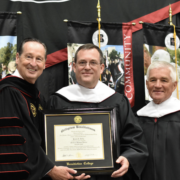
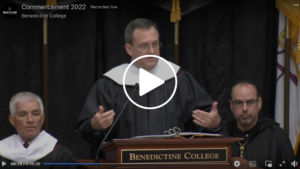
On Saturday, May 14, Patrick Reilly, president and founder of the Cardinal Newman Society, was awarded an honorary Doctor of Humane Letters degree from Benedictine College.

The award is in recognition of the Cardinal Newman Society’s work for 29 years in promoting and defending faithful Catholic education. Benedictine College is recognized in The Newman Guide for its fidelity and Catholic formation of students including Patrick’s oldest son, who graduated during the same ceremony.

College President Steve Minnis asked the graduating students to raise their hands if they were influenced by The Newman Guide.

“It is a great blessing to see the large number of students and families impacted by our work at the Cardinal Newman Society,” said Reilly. “I dedicated the award to the Society’s amazing staff, and I thanked all those who are working toward the renewal of faithful Catholic education. This special award is also a testament to our devoted members, who have prayed and sacrificed to support the Cardinal Newman Society’s vital efforts.”


‘Study with the Best’ at a Newman Guide College, Says Founder of Popular Catholic Website

Shaun McAfee

EpicPew.com—a Catholic website known for its humor and the creative approach it takes to share about the Faith—had its origin at a faithful Catholic college recommended in The Newman Guide. Now the founder of EpicPew recommends faithful Catholic colleges to families looking to “study with the best and grow deeper in the Faith.”

In 2013, when Shaun McAfee was enrolled online at Holy Apostles College and Seminary, which is recommended in The Newman Guide, he was classmates with a number of energetic friends who were interested in writing like he was. They were asked to resurrect the College’s “Dead Philosopher Society,” based on the “Dead Poets Society” from the popular film.

“The team assembled and wrote on various topics of theology, philosophy, and the defense of the Faith and morals,” he explained. “But soon we all graduated and didn’t want to disband, so we carried this to what became EpicPew.”

“The idea was the same,” he continued. “Write about the Church, apologetics, and culture, but in a fun and enthusiastic style. So, with these friends, most of them classmates, like Abby and Doug Johnson, Chloe Langr, and others, we launched the site in 2014.”

This successful website has been even more fun to maintain. “It’s been a hoot, and we’ve evolved the style, approach, and model. It’s a really fun group to be part of, and I’m still thrilled when someone mentions EpicPew or when a person I meet around the internet or real-world raves about the site.”

This website wouldn’t be possible without the stellar education offered by Holy Apostles, where McAfee earned a master’s degree in dogmatic theology. As he explained, “I had a wonderful time, semester to semester, exploring the rich teachings of the Church on several subjects such as Mariology, systematic theology, the sacraments, and the Church Fathers.”

Even though McAfee has a day job, he has continued to apply himself to personal study and writing. “[Since graduation], I have written about 800 articles online and 11 books to date. It’s been a whirlwind, but I rest my success on the great methods and resources I discovered at Holy Apostles, not to mention all the networking I was able to do.”

“Holy Apostles showed me that although I had mastered some subjects, there is no end to the topics a Catholic can study (and write on) and perhaps even contribute some understanding to the field.”

McAfee praised the Newman Guide colleges: “One can spend all 12 years of primary school in a ‘Catholic school’ and be catechized but not evangelized. I know there is something special, then, about these Newman Guide schools and how the entire approach to studies is oriented to conversion and intellectual discipleship. I have been asked several times, ‘How do I choose a good Catholic school?’ and I always say, ‘Read the Newman Guide online.’ It’s good advice if you want to study with the best and grow deeper in Faith.”

For McAfee, what sets Holy Apostles apart from all others is the “flexibility and high quality of online students. I earned my degree with a full-time job and several young kids. Others have even greater life demands to overcome and Holy Apostles routinely satisfies the demand for even the toughest schedules. Oh, and I can’t forget to mention that it’s very affordable!”

Catholic Identity Must Be Clearly Stated

One week before Easter, we sent to you the latest article written by Patrick Reilly – 10 Key Takeaways From the Vatican’s New Instruction on Catholic Education.

The article summarized the latest document from the Congregation for Catholic Education and said the document could help tremendously, “if dioceses take to heart its demands for truly faithful Catholic teaching across all subjects, hiring teachers who profess and witness to the Catholic faith, and intervening meaningfully when a school or teacher fails to provide faithful Catholic formation.”

It didn’t take long for a telltale case to appear in the news. A Jesuit-run middle school in central Massachusetts has been flying a “Black Lives Matter” flag and a rainbow flag beneath the American flag outside its school building. The local Bishop directed the school to take the flags down, but the school refused. In an interview for National Catholic Register, Reilly shares some ways these conflicts can and should be resolved in the future.

Continue reading at the National Catholic Register…


10 Key Takeaways From the Vatican’s New Instruction on Catholic Education

Recently, the Vatican issued a call for stronger Catholic identity in Catholic education. But will it do any good?

The short answer: Yes, I think it will. The Congregation for Catholic Education’s new instruction on schools, “The Identity of a Catholic School for a Culture of Dialogue,” published March 29, could help tremendously, if dioceses take to heart its demands for truly faithful Catholic teaching across all subjects, hiring teachers who profess and witness to the Catholic faith, and intervening meaningfully when a school or teacher fails to provide faithful Catholic formation.

Catholic families have been waiting more than 50 years for such firm commitment to Catholic identity, and already we have seen some exciting examples of dioceses and parochial schools overcoming the poor catechesis, poor formation and high costs that eroded much of Catholic education in past decades. We have also seen the growth of lay-run independent schools, homeschool programs and hybrid home-and-school programs that are serving a wide range of Catholic families.

All dioceses can build upon these models to ensure a strong backbone of fidelity and authentic Christian formation in parochial schools and especially schools affiliated with religious orders — or if necessary, shut them down.

Here are 10 key takeaways from the Vatican’s instruction.

1. Human Right to Education

The instruction echoes the Vatican II declaration on Christian education (Gravissimum Educationis) that “education, as the formation of the human person, is a universal right.” That’s because human nature is always inclined toward truth and has an insatiable thirst for knowledge and understanding of oneself and reality.

2. Catholic Education Is Better Education

Any education should be “aimed at the integral education” of its students — which means not only intellectual but also moral, social and cultural formation. Catholic education participates in the “evangelizing mission of the Church” by upholding and teaching the truths of the Catholic faith. When “reason enters into dialogue with faith,” students are better able to “transcend the mere data of the empirical and rational sciences” and rise to a better knowledge and understanding of the world, themselves and God.

3. ‘Every Act in Accord With Catholic Identity’

The Congregation for Catholic Education declares that “every official act of the school must be in accordance with its Catholic identity.” Importantly, this runs across all academic subjects, not just religion class. And Catholic moral and social formation are also entwined with all the activities of Catholic education. The congregation says, “… there is no separation between time for learning and time for formation, between acquiring notions and growing in wisdom.” The school must “order the whole of human culture to the news of salvation.” For educators wishing to further explore Catholic identity according to the congregation’s past documents, I recommend Principles of Catholic Identity in Education.

4. Catholic Education Is for Catholic Families

According to the Vatican instruction, Catholic education is primarily intended for Catholics, or at least Christians, for the growth and evangelization “of those who are already walking towards the fullness of Christ’s life.” The document encourages inclusive policies to help those on the margins and warns against excluding those who are not deemed “totally” Catholic, while stressing that there can be no compromise to the truths of Catholic teaching or the purpose of Catholic formation.

5. Parents Direct Their Child’s Education

While the Church has the duty of evangelizing all people, the primary responsibility for the Catholic education of a child rests with the parents. Parents are “bound by the obligation” to provide a Catholic education, the congregation says, but “they have the right to choose the means and institutions through which” that education is provided. This explicit acknowledgment will be a comfort to homeschoolers.

6. Catholic Schools Need Clear Policies

The congregation rightly instructs schools to establish formal guidelines, mission statements, employee policies, etc. to ensure fidelity and faithful evangelization. I find this especially gratifying and of the greatest importance. Convinced of the necessity of clearly stated and consistently implemented policies that protect schools from false ideologies, lukewarm faith and threats to religious freedom, the Cardinal Newman Society has been working with education experts these last few years to provide recommended standards for every aspect of Catholic education — from academics to athletics to sexuality policies.

7. Obligations of Every Employee

The Vatican affirms also that every member of the school community “has the obligation to recognize, respect, and bear witness to the Catholic identity of the school.” This includes “the non-teaching personnel,” for whom schools should “formulate clear criteria for discernment regarding the professional qualities, adherence to the Church’s doctrine, and consistency in the Christian life of the candidates.” This is a pleasant surprise! Two years ago, we thought it might be controversial when my colleague Dan Guernsey, senior fellow at the Cardinal Newman Society, argued for a “deep, permeating unity of purpose and conduct” among both teaching and non-teaching employees and urged moral standards for non-teaching employees.

8. Obligations of Every Teacher

As for teachers, the congregation says that everyone (not just religion teachers) must be equipped with the “secular and religious knowledge” necessary to relate Catholic doctrine to their teaching. This is another surprise, challenging schools to hire well-formed teachers in all subjects — ideally, I would argue, graduates of the faithful Newman Guide colleges. The instruction says that, “by their life as much as by their instruction,” teachers must “bear witness to Christ, the unique Teacher” — which seems a clear note of support for schools dismissing teachers in same-sex civil unions. These teacher expectations are repeated elsewhere in the instruction.

9. Teachers Hold Ecclesiastical Offices

Moreover, the Vatican affirms that the work of all Catholic school teachers “is in the real sense of the word an apostolate.” It later establishes the teacher — again, not only the religion teacher — as an ecclesiastical office according to Canons 145 and 936. This is a huge development with relevance to the “ministerial exception” that protects American Catholic schools from anti-discrimination lawsuits by ministers of the Church.

10. Bishops Have Great Authority Over Schools

Because every Catholic school teacher holds a divine office, the bishop has the right to demand the removal of a teacher even at a school not controlled by the diocese, such as a Jesuit school. The Congregation’s instruction clarifies that even non-diocesan schools are obligated to follow all of the bishop’s precepts regarding Catholic identity in education. A bishop cannot remove the “Catholic” label from a school affiliated with a religious order, which is de facto Catholic by its affiliation, but the bishop could expel the school or the order from his diocese. (Expect a Vatican ruling on the Brebeuf Jesuit Preparatory School scandal soon.)

There is much more to ponder in the congregation’s instruction, but it seems appropriate to end on the same hopeful note as the document, which reminds us of Catholic education’s evangelical mission: “… it is vitally important for the Church today to go forth and preach the Gospel to all: to all places, on all occasions, without hesitation, reluctance, or fear.”

In this quote from Evangelii Gaudium, Pope Francis sounds a lot like Pope St. John Paul II, who was devoted to the task of renewing faithful Catholic education. May St. John Paul II pray with us, that this renewal comes to fruition, for the glory of God and the good of his children.


This article first appeared at the National Catholic Register.