On Receipt of the Lumen Vitae Medal

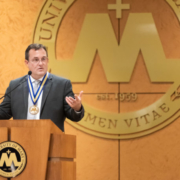
Address to Award Dinner at University of Mary, Bismarck, N.D.
Given October 23, 2018

One of the many reasons I appreciate this award is that it provides a welcome opportunity to consider all of God’s blessings to me and The Cardinal Newman Society over 25 years. Although it’s the Newman Society’s 25th anniversary, we haven’t had much time to celebrate. So, this is our celebration.

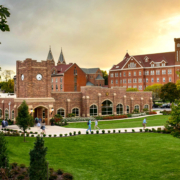
And I can’t think of a better way to celebrate than with our good friends at the University of Mary. What the University of Mary has achieved in recent years is incredible, and the Newman Society has been compelled not only to recognize this success but to promote it to Catholic families across the country. The University of Mary today is an inspiring example for the renewal of faithful Catholic education and a beacon of light in the otherwise dark landscape of Catholic higher education that has been largely secularized.

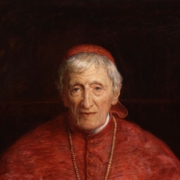
Our patron, Blessed John Henry Newman, was ultimately unable to see his splendid “idea” of an authentic Catholic university come to fruition in Dublin. But Msgr. Shea, leaders, and faculty of the University of Mary, you are truly building it right here in Bismarck!

In my 25 years with The Cardinal Newman Society, I have seen God bring about wonderful improvements in Catholic education. It’s so exciting! Several of the colleges that we recommend in our Newman Guide today weren’t in the initial guide more than a decade ago. Today the Newman Guide colleges are the gold standard for families seeking faithful Catholic education, and many Newman Guide colleges enjoyed record enrollment numbers this year, despite the fact that other private colleges around the country had a very tough year.

There is good news also in Catholic elementary and secondary education. While many parochial and diocesan schools are still closing, many of the schools that have a strong focus on mission and intentionally form saints have done very well. You’ll find many of these schools on our Catholic Education Honor Roll. Catholic homeschoolers and lay-led independent schools continue to increase. Their devotion to Christian formation and their ability to test both classical and innovative methods of teaching have been a boon to the Church. The widespread adoption of the Common Core in Catholic schools, which the Newman Society opposed, opened many eyes to the flawed practice of simply adopting secular state standards to guide Catholic education. Now the Newman Society’s Catholic Curriculum Standards are being used by 20 dioceses and other Catholic schools serving more than a quarter million students.

So in the past 25 years, God has truly blessed the renewal of Catholic education. And for The Cardinal Newman Society specifically, I am so grateful for all the marvelous ways God has brought such good out of our humble work.

I am sure that Monsignor Shea can attest to the many times a new idea or program begins with a stumble, and then God does such incredible things with it. It’s happened to the Newman Society so many times. And that, to me, is what this Lumen Vitae Award most importantly honors: the Grace of God, and what He has wrought through our service to Him.

That service depends heavily on some quite amazing people who advise me on our board of directors and those on my staff who do the work I’m not qualified to do. Two of them—Tom Mead and Cindy Laird—have been with me for well over a decade and during the Newman Society’s most productive years. Two of my other staff heroes are here tonight: our Vice President Bob Laird and his wife Gerri Laird, both of whom have done enormous work for the Newman Society in a variety of roles—and they have done so much for the Church in other ways as well. There are others back in Virginia, Florida, North Carolina, and elsewhere,  who helped carry the Newman Society through these 25 years and also have been great inspirations to me because of their personal example.

Our donors, too, have been such a blessing, and not only for the obvious reason that their generosity is incredibly important to the Newman Society’s success. Even more, I’ve met many of them from all walks of life, and universally they have impressed me by their extraordinary goodness and devotion to the Church. They have been role models for my own personal and spiritual growth. That couldn’t be more true than it is of Deacon George and Marilyn Loegering, whose presence here tonight is yet one more demonstration of their kindness and friendship for so many years. Thank you!

It is also certainly true of the many educators with whom we work closely, including Monsignor Shea and several others among you here at the University of Mary. These are some of the most impressive people I know. I thank God for raising up such devoted and faithful educators.

Last but most, there are some people here who made a long trip because they love me and care for me so much, and I have depended on them for strength every day. My mother Mary Kay is here, and I know that my dad is here also in spirit. They gave so much of themselves for my own formation, and they were and always will be my models of Catholic education.

And my wife Rosario, teacher to my children and the light in my crazy life: her extraordinary insight about Catholic education and her example in founding and persevering with the Aquinas Learning hybrid program shapes my work with the Newman Society in every way. God has also wrought great things from her work. She has been with me and the Newman Society since its earliest days.

And my kids—Ana, Daniel, Nicholas, Joseph, and one more, Ian, who couldn’t be here—I am so proud of them and what they have taught me and their mom, even as we have tried to teach them.

So, you can see that God has surrounded me with magnificent people, which makes it difficult to fail. When Monsignor Shea offered me the Lumen Vitae award for my work with The Cardinal Newman Society, I was overwhelmed as always by the generosity and encouragement that he and the University of Mary have shown for our work to renew faithful Catholic education. But I asked his permission if I might at least verbally share this award with all those by whom God has brought about The Cardinal Newman Society’s 25 years of success.

And so I do want all those I mentioned to share in it, because you are such an important part of this work.

I don’t want to speak too long, but given these times we live in, I want to just add some brief observations concerning scandal and Catholic education’s response to it.

Jesus said that His own generation was an “evil generation.” But we too have come through such an awful year for the Church. I have found myself at times having difficulty working, because the bad news was flooding in so fast, and the betrayal by many of our priests and bishops is so depressing.

The Youth Synod this month was also disappointing. It exposed an astonishing lack of confidence among some Church leaders in the ability of the Church to teach the Faith to our young people. This lack of confidence in the teaching mission of the Church among perhaps most Catholic adults today is, in itself, a scandal to the young.

Scandal, of course, is nothing new to The Cardinal Newman Society. I founded the organization based on my own experience at a large Jesuit university. As editor of the student newspaper, I wrote about the scandals, eventually getting the attention of the local Cardinal. When a university official locked me out of the student newspaper office, I sent letters to top alumni donors, forcing the university to end its support of two radical student organizations.

A few years later, in Washington, D.C., I met several other young Catholics who felt the same anger and betrayal that I experienced, because of similar scandals at their Catholic colleges. But we didn’t lack confidence or hope in the Church, and we weren’t content to leave other young people in harm’s way. Instead, we worked together to establish The Cardinal Newman Society.

My point is that scandal deserves a bold and confident response. I was raised in the Saint John Paul II generation, and I take to heart his reminder of Jesus’ words, “Be not afraid!” Today’s scandals in the Church may be different in kind from what we experienced at wayward Catholic colleges. But still, I believe the response must be the same: a strong show of confidence in the Church that Christ established, and a renewed effort to propose and defend her teachings. A faithful Catholic university like the University of Mary can play a significant role in that.

Indeed, I would say that faithful Catholic education is the key solution to the challenges facing the Church. We need new generations of wise and virtuous Catholics who know and love Jesus in the Faith and traditions of His Church.  We need them to renew the priesthood, renew the Church, and renew the culture.

But to get there, we adults can’t lack confidence in the truth of Christ’s teaching.

We can’t lack confidence in the role of parents as primary educators of their children.

We can’t lack confidence in Christ’s promise that the Church will prevail.

And we can’t lack confidence that God will reward those who stand firmly in the Faith.

On the other hand, we can’t doubt Christ’s words, that he who scandalizes young people would be better off “if a great millstone were put around his neck and he were thrown into the sea.” Believe it! And if we believe it, then we will stand as adults should and protect our young people from the harm that seems to await them on all sides.

Faithful Catholic education is the strength and the shield that we need to provide them. Forming them in both truth and love – in the skills of reasoning and the knowledge of Christ – is what young people need today to resist temptation to hopelessness and relativism.

If young Catholics cannot think reasonably, they will be unable to withstand the lies that our secular culture feeds them. Catholic education must return to its emphasis on forming the minds of young people, not just filling their heads with information.

But even more, Catholic education must lead young people to Christ. We must understand formation in the Catholic school or college as guiding young people into sainthood.

I am reminded of the 12th-century dispute between St. Bernard of Clairvaux and Peter Abelard, just as the first modern universities were on the rise. St. Bernard championed a “theology of the heart” that sought understanding of God not by reason but by prayer and adoration. Peter Abelard was an early scholastic who sought understanding of God by using reason to study the truths of the Faith. It was Abelard’s approach and the wisdom of scholastics like Thomas Aquinas that gave prominence to the great Catholic universities.

But can we claim that reason remains truly central to education today at many universities? Are young people prepared to recognize and understand truth? A Catholic school or college that truly forms young people in reason is a gift that our Church and culture sorely need today.

Still, Pope Benedict XVI warned American Catholic educators in 2008 that the “contemporary crisis of truth” which so deeply affects our young people is, at its heart, a “crisis of faith.”[1] In the 12th century, St. Bernard warned that there is “grave danger” in becoming too focused on reason in matters of faith. The result, he said, would be “intellectualism, the relativizing of truth, and the questioning of the truths of faith themselves.”[2]

Isn’t that an apt description of much of what ails Catholic education today? The irony is that while we do suffer these consequences, it can’t be because there is too much emphasis on rationality in our Catholic schools and colleges; if anything, reason is lacking. Instead, we find ourselves in an odd time when universities still lay claim to being the intellectual centers of our culture—and indeed there may still be valuable and reasoned dialogue among bright lights on college faculties—but young people are not being formed to carry on the conversation. At the same time, under the guise of rationality, God Himself is excluded.

Saint John Paul II said that “a Catholic university’s privileged task is ‘to unite existentially by intellectual effort two orders of reality that too frequently tend to be placed in opposition as though they were antithetical: the search for truth, and the certainty of already knowing the fount of truth’.”[3] Rediscovering the fount or source of truth in God, as well as recommitting to the scholastic ideal of rational exploration of our Faith with skilled reasoning and complete fidelity to the Church, are essential to the renewal of Catholic education.

Seeing this renewal play out at exceptional institutions like the University of Mary is, for me, the greatest gift after 25 years of promoting and defending faithful Catholic education. I see in the University’s leaders true love and devotion for God, and understanding that He is the source of wisdom and all reality. From that foundation, a great Catholic university is built.

I was thrilled to see on the University of Mary website a quote from Blessed John Henry Newman that I have cited many times, and it is as fitting now as ever to conclude with this thought:

“This is our hour, whatever be its duration: the hour for great hopes, great schemes, great efforts, great beginnings. We may live indeed to see but little built, but we shall see much founded. A new era seems to be at hand, and a bolder policy is showing itself… to recommence the Age of Universities.”[4]

[1] Pope Benedict XVI, “Address to Catholic Educators at The Catholic University of America” (Washington, D.C., April 17, 2008); retrieved from http://w2.vatican.va/content/benedict-xvi/en/speeches/2008/april/documents/hf_ben-xvi_spe_20080417_cath-univ-washington.html

[2] Pope Benedict XVI, General Audience (Vatican, Nov. 4, 2009); retrieved from https://w2.vatican.va/content/benedict-xvi/en/audiences/2009/documents/hf_ben-xvi_aud_20091104.html

[3] Pope Saint John Paul II, Ex corde Ecclesiae (Vatican, 1990), 1; retrieved from http://w2.vatican.va/content/john-paul-ii/en/apost_constitutions/documents/hf_jp-ii_apc_15081990_ex-corde-ecclesiae.html

[4] Newman, Historical Sketches: Volume III, 251.

Arlington Bishop to Homeschooling Families: “Thank You”

An American bishop stood strong last week in support of Catholic homeschoolers, just days after some bishops at the Youth Synod in Rome reported comments that were offensive to homeschool parents.

On Friday, Bishop Michael Burbidge of the Diocese of Arlington celebrated his second annual Mass for homeschooling families. The Diocese reported “hundreds” in attendance.

“Dear parents thank you so much for taking seriously that responsibility of being the first teachers of the faith,” Bishop Burbidge said during his homily at Holy Trinity Church in Gainesville, Virginia, according to the Arlington Catholic Herald.

His words were especially welcome, after an unnamed group of English-speaking bishops at the Youth Synod questioned in their interim report on Oct. 9 whether parents are “qualified” to teach their children. The bishops claimed an “ideological basis” to homeschooling and noted that the U.S. bishops are “not united” in support of the practice.

Bishop Burbidge, however, clearly sees how important homeschooling has been to Catholic families in his diocese. More from Saturday’s article in the Herald:

“You may not always see the visible and immediate results that you want as homeschool teachers, but you can be assured that the seeds you are planting God will use miraculously. Thank you for the gift you are to the diocese and to our church,” Bishop Burbidge said.

Throughout the day, organizers of the event and parents expressed their gratitude for his presence.

“It really shows the commitment of the bishop to Catholic education. Whether it is in the schools or in recognizing the importance of the homeschooling community, in both ways he supports parents as the primary educators of their children,” said Diocesan Superintendent of Schools Jennifer Bigelow.

Mary Beth Balint, a homeschooling parent of six children, was thrilled about the Mass, too.

“I was so excited that Bishop Burbidge wanted to offer a Mass for homeschoolers,” said Balint, a key organizer for this year’s event as well as last year’s. “It is just great to have the support and prayers from him. I was eager to jump in and help organize the outdoor activities for the kids after the Mass.”

The support shown by Bishop Burbidge and other bishops holding similar events is a great encouragement to Catholic homeschoolers, who can feel disconnected and even disliked by priests and fellow parishioners. Bishop Burbidge also celebrated an annual homeschool Mass while bishop of Raleigh, North Carolina.

Hopefully such expressions of support are just the beginning of a healthier perspective on Catholic education. While the renewal of faithful parochial and diocesan schools should be among the highest priorities for the Church, so should the growth of Catholic homeschooling and lay-run independent schools that teach the Catholic faith. A corporate mindset that sees these alternatives as competition with the diocesan “brand” is not looking out for the needs of all Catholic families.

When every bishop and diocesan education office actively supports all forms of faithful Catholic education and withdraws support and recognition from institutions that fail to form young people in virtue and faith, we can expect a renewal of Catholic education, the family and the Church.

“Parents are the first and most important educators of their own children, and they also possess a fundamental competence in this area: they are educators because they are parents,” affirmed Saint John Paul II in his Letter to Families. God has blessed homeschooling in many ways, and I pray that it continues to gain the support of the Church’s shepherds.

This article was first posted at The National Catholic Register.

Synod Report Displays Ignorance About Homeschooling

At the Youth Synod in Rome this week, one of the bishops’ discussion groups made some disappointing and ignorant comments about Catholic homeschoolers.

It’s a sad reminder that, while homeschooling seems to be gaining support from many bishops in the United States, other bishops here and abroad have yet to embrace one of the most promising developments in the Church today. Earnest and faithful homeschooling parents deserve encouragement and not derision from their shepherds.

The report from the English-language Group C bishops—whose names have not been published—reads:

  • USA has many home schoolers – bishops in USA are not united, as homeschooling can have an ideological basis – kids may have special needs
  • are parents qualified to homeschool them?

It is certainly true that the American bishops are not united in supporting homeschooling, and that is a shame. But what’s the “ideological basis” for homeschooling? Do the bishops perceive some absolute opposition to organized education? It’s not true; many homeschooled students have, at one time or another, attended schools or participated in collaborative programs.

More likely, Group C’s “ideological” comment means something else. It’s what faithful Catholic homeschoolers endure frequently from fellow Catholics, priests and even bishops—the charge that they are too “conservative” and too “moralistic.”

In my experience, those are code words for simply being faithful—for practicing the “old” ways of prayer, sacrament and moral discipline.

As a father of five homeschooled children, teacher at a weekly hybrid Catholic program for homeschoolers that is directed by my wife, and full-time advocate of faithful Catholic education, I have come to know hundreds of Catholic homeschooling families. They are trying to be faithfully Catholic in all that they do. And a key reason for not attending local Catholic schools, aside from the cost, is that too many of the schools lack strong moral and religious formation.

That’s not ideological. It’s responsible Catholic parenting.

In my homeschool community—and in the growing number of parochial, diocesan and lay-run, independent Catholic schools that have embraced the Church’s vision for Catholic education—I see primarily parents who are deeply concerned for the Christian formation of their children. They make great sacrifices to provide the education that their children deserve. And they do so, despite the often demoralizing sneers and snickers of too many in the Church.

As for the Synod bishops’ question whether parents are “qualified to homeschool” their children, it’s not clear whether the question refers to all children or only those with “special needs.” Regardless, the question shows disrespect toward parents. Every parent who is faithfully Catholic and truly loves their child is “qualified” to homeschool by the grace of God. If they lack certain skills or expertise, a loving parent will get the help their child needs, without yielding parental authority and oversight.

Trusting parents to form and care for their children is Catholic teaching! It is inherent to matrimony, reinforced during child baptism, and follows from the Fourth Commandment. And it can be made easier if parishes and dioceses actively support—not control or direct, but support—parents who choose to homeschool.

God has clearly blessed Catholic homeschooling with extraordinary results for children, families and the Church. The academic, financial, and social benefits of homeschooling have been well-documented in many studies. Moreover, homeschooled families are often represented at daily Mass, regular Sunday Mass, Confession, Eucharistic adoration and many parish activities. One recent study found that homeschooled students account for about 10 percent of priestly vocations today.

This isn’t a well-kept secret! But some of the Synod bishops have some learning to do.

Meanwhile, if America’s bishops and other Catholics are truly divided over homeschooling, then they ought to get over their discomfort. The Church should embrace faithful Catholic education in whatever form successfully leads young people to Christ and helps them become fully human—whether at home, online or in a brick-and-mortar school.

Support for homeschooling and for lay-run schools may be new to dioceses that have historically relied on schools owned and directed by priests and bishops. But we can’t confuse method for mission, which is amply served by the growing alternatives in Catholic education. All we need is to trust parents to do the job that God has already entrusted to them.

This article first appeared at The National Catholic Register.

Youth Synod Needs Good News from Faithful Catholic Colleges

October’s Synod on Young People comes amid growing awareness of the Catholic Church’s many failures to teach, inspire, and even protect its young. But if the synod fathers are looking for good news, there’s plenty to be found at America’s most faithful Catholic colleges—and these can be examples for the entire Church.

Papal biographer and columnist George Weigel recently urged that “Success stories in youth ministry should be persistently, even relentlessly, lifted up” at the synod. He specifically noted the “intellectual and spiritual achievements of orthodox, academically vibrant Catholic liberal arts colleges and universities in the United States.”

As editor of The Newman Guide, I couldn’t agree more! The faithful Catholic colleges recommended by The Cardinal Newman Society are accomplishing much, for the good of their students and for the Church. And since the mission of the Church is evangelization, and Catholic education is a key means of evangelization, it would only make sense that faithful Catholic colleges would be held up as examples for the Synod on Young People.

Just recently, the U.S. News and World Report rankings were released, and many Newman Guide colleges earned high marks in various categories. But more important than secular rankings, faithful education help provide the formation that young Catholics deserve and which is lacking across much of the Church today.

This formation is offered through faithful theology courses, strong liberal arts core curricula, the witness of faithful leaders on campus, the focus on reverent liturgy and prayer, a healthy campus culture, athletic programs that encourage virtue, and so much more.

Dr. John Grabowski, associate professor of moral theology and ethics at The Catholic University of America in Washington, D.C., explains that studying philosophy and theology “enables the young adult to ‘own’ the faith which their parents, priests, and other teachers had passed on to them.” He recalls, “One of the most rewarding and humbling things that has occurred in my years of teaching is to have students enter the Church or come back to the faith after taking a class and tell me that the course helped them to make that decision.”

That’s a far cry from the scandal and confusion sown by wayward Catholic colleges, such as those that hosted seminars earlier this year on Amoris Laetitia with theologians who are well-known for their attempts to change the Church’s teaching and traditions.

The core curriculum and faculty at a faithful Catholic college are focused on a student’s formation in the light of faith, not in opposition to it. “All students, Catholic and non-Catholic, deserve an education that awakens wonder and is oriented to an integrated wisdom, both theoretical and practical,” says Dr. Josh Hochschild, professor of philosophy at Mount St. Mary’s University in Emmitsburg, Maryland. A strong curriculum is “crucial to help students experience the unity of truth,” he says, but just as important is “the character of the faculty.”

“In any discipline, faculty can help embody confidence and humility of the pursuit of truth, and the example of Christian witness in faculty is a profound grace to students,” Hochschild explains. “The whole campus culture has a role in supporting this vision.”

The faithful colleges held up for example in The Newman Guide often go above and beyond to ensure that students have good role models on campus. Steve Minnis, president of Benedictine College in Atchison, Kansas, told us: “I interview every job applicant on campus, and I ask them to explain to me how they see themselves contributing to our mission—not just accept that we have a mission, but how they will support it. I want every man or woman who works for Benedictine College to be someone I hope our students will aspire to be like.”

Another thing that is at the heart of a faithful Catholic college is the liturgy, which is something that George Harne, president of Northeast Catholic College in Warner, New Hampshire, has often emphasized. And when asked how the College is forming young people in the truth of our faith, several students noted the liturgical life on campus.

Sophomore Rose Phelps says, “Most importantly, the way the liturgy is celebrated at NCC has truly helped me deepen my relationship with God. The reverence of the priests and altar servers along with the beautiful chant and polyphony music make it so easy to lift ones heart to God.”

Senior Rebecca Stolarski agrees. “The spiritual resources available to students [on campus]—daily Mass, Rosary, Adoration, Confession—should not be underestimated: there are few things more spiritual restorative than an evening before the Blessed Sacrament, and nothing more strengthening to faith than convenient access to daily Mass.”

Faithful colleges attend to the entire campus culture. Some great examples are the wholesome activities offered through the outdoor adventures program at Wyoming Catholic College, the Rome campus program offered through the University of Dallas, and the “household” systems at Ave Maria University and Franciscan University of Steubenville that invite groups of students to live and pray together. Benedictine College’s Minnis says the key is to make it “contagious to live the good life” and to let the “good things run wild.”

Formation extends into the realm of athletics. At Belmont Abbey College in Belmont, North Carolina, President Bill Thierfelder is a former Olympian who stresses virtue in all athletic programs. It’s no surprise that student athletes have helped the College earn the sportsmanship award from its Division II athletics conference in four of the last seven years.

All areas on campus should help form students, according to Michael McMahon, vice president for enrollment management at the University of Mary in Bismarck, North Dakota “Through academics, residence life, and even athletics—all seeking truth, students understand that truth is not disjointed or that our lives can be compartmentalized,” he says. “If it is true in the theology course, it needs to also be true in the residence life halls. If the faculty and administration of a university are not faithful to the Church’s teachings why would our students be inspired to be?”

Joseph Nemec, a junior at the University of St. Thomas in Houston, Texas, says, “I am grateful to God for the opportunity to study at an institution that values the very things young people want and need.”

Often when parents and students think of college, they think of education. But an education at a faithful Catholic college is about so much more: it’s about formation. This formation shapes a student’s body, mind, and soul and prepares a student for his or her vocation, as well as a career.

The impact of faithful Catholic colleges is impressive! In just 40 years with an enrollment of 500 students, Christendom College in Front Royal, Virginia, has helped foster 158 religious vocations. Additionally, there have been 419 alumna-to-alumnus marriages. Thomas Aquinas College in Santa Paula, California, was once asked by the Vatican’s Congregation for Catholic Education to give an account for why so many priestly and religious vocations come from the College.

Maybe it’s time for the Synod on Young People to ask Newman Guide colleges to give an account for their success in youth formation. These joyfully Catholic institutions provide an example of fidelity and success that can be a shining light to anyone who is trying to bring Christ to new generations.

This article was originally published by National Catholic Register.

So Many Choices: How to Know Which College Is Right for You

The typical advice you will read in books and hear from well-meaning friends and advisors focuses on two priorities in the college search:  Will the college help you get a good job? And will you have fun?  But there’s much more to choosing a college!

Don’t get us wrong: both questions above are important. College is expensive, and the reality of our modern society is that, for right or wrong, a lot of careers require a college degre. And while you’re working hard at it, why go someplace where you’ll be miserable?

But keep in mind several other key priorities, such as whether you’ll get a good education, sustain and grow in your faith, cultivate your talents, discern your calling from God, and discover or confirm your vocation in life—whether it’s marriage, the priesthood, religious life, or the single life.

Faithful Catholic colleges — like those recommended at The Newman Guide online — can help you do all this and more.

Finding the right college for you boils down to a few things:

  1. who you are and what you need to be successful,
  2. your calling and goals for the future, and
  3. whether a college serves your needs, given your answers to numbers 1 and 2.

CONSIDER YOUR PERSONALITY

Are you an extrovert or an introvert? Will you learn more and succeed in small classes or in larger ones?

Are you self-motivated, or do you need more structure to succeed?

Faithful Catholic colleges range in size from 50 students to more than 8,000 students. Some are on small campuses located in the heart of a city, while others are on sprawling campuses in rural areas. Consider your personality and the environment that would best help you succeed.

REFLECT ON YOUR FAITH

Is your faith as strong as a rock, or is it shaky? Do you prefer a particular kind of liturgical environment—like praise and worship, or more traditional Masses—to keep you motivated to attend Mass at least every Sunday?

Are you tempted by certain kinds of sins?

What environment will help you avoid them?

Faithful Catholic colleges offer not only a terrific education but also a campus environment that can help you sustain and deepen your faith during your college years. The typical college culture may celebrate some things as “fun”—whether it is gossiping, binge drinking, the hook-up culture, or any other number of things—but as a Catholic, you know that these things hurt you. Put yourself in a campus environment that will help you be holy!

EVALUATE ACADEMIC & EXTRACURRICULAR GOALS

Are there particular sports, clubs or activities that you want to participate in during college?

Do you know the field or course of study you are you interested in, or are you still trying to figure that out?

Faithful Catholic colleges provide a strong liberal arts core curriculum, rooted in the Catholic tradition. This not only prepares you for a particular career but also for life.

You can choose from a wide variety of majors at faithful Catholic colleges, and you will be prepared to excel. For example, if you study nursing, you’ll be ready to respond to ethical dilemmas in the workplace. If you become a math or a history teacher, you’ll know how to teach and share the faith with students.

TAKE THE NEXT STEPS

Once you have thought about these questions, the next step is to dig in and research the colleges that are on your short list.  The Newman Guide online and college websites are good places to study the various aspects of the colleges that are most important to you.

But don’t stop there! Call or e-mail college professors and staff in addition to your admissions officer.

Use social media networks to find current and recent students, asking them about their experiences.

The most important part of your evaluation involves a field trip—the campus visit!

Searching for a college doesn’t have to be difficult, but it does take a lot of thought, research, and soul searching. Pray for guidance. With your parents, decide on a college that will provide a strong education and bring you closer to Christ.

10 Poems Everyone Should Learn by Heart

The world is so full of a number of things,
I’m sure we should all be as happy as kings.

Considering how much unhappiness there is in the world today, there might be a temptation to dismiss this poem and its ilk as an optimistic delusion. There is a sad tendency to view the world as a wasteland rather than a wonderland. This is, perhaps, one of the deepest errors of our time, the error of cynicism. What the world needs, what people need, what Catholics need, is a psychological and spiritual renewal: a renewal of politics, culture, parenthood, education… and poetry.

There is an old proverb that says if a person does not learn poetry as a child, they will not know how to pray as an adult. A more arresting thing could hardly be said, especially in an age where poetry is dead, either shrugged off with indifference or dismissed as unimportant.

Without doubt, the Church and the world need scientists and soldiers in the cultural and spiritual war zones to defend the Faith. But, in as much as civilization needs such professionals, so too does it need poets—and that for a very simple reason. Scientists without poetry can be slaves to systems. Soldiers without poetry can be barbarians devoid of chivalry. A people without poetry cannot be effective missionaries, because the charm of the Faith shines with poetry. Without poetry, without some knowledge or expression of Goodness, Truth, and Beauty, there is less hope of attaining the glorious end of martyrdom—whether through war, marriage, work, or any given Tuesday.

Poetry offers that knowledge and expression, and thus offers children a window to view and begin to understand a world so full of “a number of things.” Poems should be lifelong teachers and they should begin their lessons in the hearts of the young. Once there, they can give satisfying expression to those mysteries of childhood that are beyond a child’s ability to express. And in so doing, poetry can begin to introduce children not only to the outward world and inward emotions, but also to give all things their proper place and relation.

Perhaps the most significant obstacle to providing today’s children with the experience of poetry is that many of today’s parents and teachers have not had the experience of poetry themselves. (It is never too late to have the experience!) Poetry—that art which meditates on beauty, rest, perfection, and the grandeur of God’s presence in nature—is good for grown-ups too. No matter how old you are, or how busy you are, it is always important to be reminded of the beauty and mystery that transcends all our distractions. And this is especially so if you are a teacher.

If you never thought about the importance of poetry in education, do not, by any means, let this article convince you. Take the time to discover great poetry. Read Shelley, Keats, and Byron. Read Wordsworth and Poe. Read the Psalms. Read Homer, Virgil, Chaucer, Shakespeare, Milton, Coleridge, and Hopkins. Write your own book inscriptions and Christmas cards to your loved ones in verse. Allow yourself the opportunity to encounter and engage the kiss of beauty.

Immerse yourself. Engage the material. And, above all else, enjoy it.

Take the time.

No parent or teacher can give their child or student what they do not have. No pupil will take to heart what is brushed off as being unimportant by their parents or teachers. If parents and teachers want their children to pray, they must pray first. If parents and teachers want their children to be good, they must be good themselves. If parents and teachers do not read and savor the poetic works, neither will their children.

The first step to giving your children the gift of poetry is to love it yourself. Following are 10 excellent poems to begin with, to learn by heart and to teach the children you know to learn by heart. The rhythms of poetry reflect the rhythms of creation, of life, and the human heart. They put profundities in the mouths of babes, fortifying them for those times when, as adults, they will cry out from the depths. The power of beauty must not be lost. Like the coming of spring, the world will be saved by beauty, and a line of poetry may make all the difference in a person’s salvation. There is nothing like a poem held in the heart, like a fire in a hearth, to give the first and final context of earthly experience.

Memorize these 10 poems with your children or your students. They are not long or difficult. Neither does it take long, nor is it difficult to incorporate them at the beginning of a class, on a walk, in the car, or at table. Teach your young minds and hearts these poems and plant the power of poetry in their lives. These are only a beginning, but they are a good start.

  1. “Requiem” by Robert Louis Stevenson
  2. “My Heart Leaps Up” by William Wordsworth
  3. “To an Athlete Dying Young” by A. E. Housman
  4. “Sea Fever” by John Masefield
  5. “Nothing Gold Can Stay” by Robert Frost
  6. “The Destruction of Sennacherib” by Lord Byron
  7. “A Red, Red Rose” by Robert Burns
  8. “Concord Hymn” by Ralph Waldo Emerson
  9. “Winter” by William Shakespeare
  10. “Psalm 8”

SEAN FITZPATRICK is a graduate of Thomas Aquinas College and serves as the headmaster of Gregory the Great Academy in Elmhurst, Pa. He also serves on the Advisory Council for Sophia Institute for Teachers. His writings on education, literature and culture have appeared in Crisis Magazine, The Imaginative Conservative, and Catholic Exchange.

John Dewey and Progressivist Education

Despite its dominance in philosophy and scientific inquiry, Enlightenment empiricism would have but minimal practical effect upon education until it manifested itself powerfully in a philosophy of education—progressivism —that came to prominence during the early years of the twentieth century.

Progressivism was largely founded by the thought and labor of John Dewey (1859-1952), a man whose mind was enraptured by the scientific method, and who expanded its use to education.[1] He took the processes of empirical science, established by such men as Sir Francis Bacon, and extended them further than most of the men of the Enlightenment would have taken them. While men such as John Locke (1632-1704) would have seen the scientific method as a means by which empiricist knowledge is gained regarding objective, physical nature, Dewey understood the scientific method as knowledge itself.[2] While at least most empiricists would have remained consistent with the ages past in holding a division between knowing and doing, Dewey abolished that division and postulated knowledge to be but mere doing.[3]He advocated a theory known as operationalism which held that knowledge is merely the scientific method in action.[4]

In his thought, Dewey reflected in many ways that of the Enlightenment philosopher Jean-Jacques Rousseau (1712-1778), who seems to have perceived the logical results of the Enlightenment better than did his contemporaries.[5] Dewey paid much heed and respect to Rousseau, who Henry T. Edmundson III described as the “single most important influence on progressive education,” both in Europe and America, although Dewey rightly criticized Rousseau’s neglect of his own children.[6] An essential point of agreement between Rousseau and Dewey was their belief in the natural goodness of man.[7]

Endorsed by pure empiricists such as John Locke, this concept of man’s innate goodness flowed naturally from the nominalist and empiricist positions.[8] In the words of Richard Weaver, “If physical nature is the totality and if man is of nature, it is impossible to think of him as suffering from constitutional evil; his defections must now be attributed to his simple ignorance or to some kind of social deprivation. One comes thus by clear deduction to the corollary of the natural goodness of man.”[9] Without universals, there is nothing to which human nature may be compared and nothing by which it may be deemed corrupted.[10] If anything is wrong with man, the ill is due to something external to man (such as a destructive environment or a lack of information) and not to man himself. Man is, as described by John Locke, born with a mind that is a tabula rasa or “blank slate,” without any natural propensity to evil.[11] The doctrine of original sin is thereby abolished.[12]

As a result of these ideas, Rousseau and Dewey promoted what has since been labeled the “child-centered” approach to education.[13] For them, education is concerned with hands-on experience and physical activities and manipulations—the only true knowledge—with an emphasis on vocational preparation.[14] They saw the rightful foundation of these endeavors as the natural impulses of the child.[15] Based upon the natural goodness of man, they charged previous education with suppressing these impulses as vices and, thereby, with suppressing the selfhood of the child.[16] These impulses should be set free from adult correction or discipline and utilized as guides for classroom activities and instruction.[17] In this way, the ideas of Dewey, reflecting those of Rousseau’s “noble savage,” led to traditional virtue and notions of sin or evil being replaced in America’s educational system by the savage’s right to be “himself,” a shift which encouraged an egocentric, i.e. selfish or prideful, approach to knowledge. The results of such a shift are all too evident in our current situation.

[1]. Clark, Gordon H. Thales to Dewey: A History of Philosophy. Grand Rapids, MI: Baker Book House, 1980,  519, 523, 525.

[2]. Ibid., 525.

[3]. Ibid., 524-525.

[4]. Ibid., 526.

[5]. Henry T. Edmondson, John Dewey & the Decline of American Education: How the Patron Saint of Schools Has Corrupted Teaching and Learning (Wilmington, DE: ISI Books, 2006), 8-9.

[6]. Ibid.

[7]. Ibid., 8.

[8]. Russell Kirk, The Roots of American Order (Washington, DC: Regnery Gateway, 1991), 406.

[9]. Richard M. Weaver, Ideas Have Consequences (Chicago: University of Chicago Press, 1984), 4-5.

[10]. Ibid., 4.

[11]. Kirk, Roots of American Order, 406.

[12]. Weaver, Ideas Have Consequences, 4.

[13]. Edmondson, John Dewey, 8.

[14]. Ibid., 8-9.

[15]. Ibid., 22.

[16]. Ibid., 8, 22, 23, 33.

[17]. Ibid., 22, 23.

DANIEL K. HUBIN resides in the Nashville, Tenn., area where he studies education, history, and literature at Welch College. He earned the Eagle Scout Award in 2014 and currently teaches U.S. government and civics to homeschool students.

Editorial: Infidelity, Dissent and Scandal—from McCarrick to Catholic Education

In light of the terrible scandals confronting the Church in recent days, may we (once again) propose a key part of the solution to widespread infidelity, dissent and scandal?

We propose the renewal of faithful Catholic education.

The Church has been repeatedly wounded by the predatory, criminal and obscene abuse of innocent boys and men by trusted leaders, including former Cardinal McCarrick and those who enabled him.

How can we still be in this situation? After the 2002 scandals, the faithful stood with the bishops and trusted them to end not just the sex abuse scandals—which we were assured were all in the past—but also to work to rebuild and strengthen Catholic identity across the Church’s institutions.

But here we are 16 years later. Church attendance is plummeting, young people are abandoning the faith, and heterodox Catholic colleges, leaders and organizations have persisted in dissent and scandal without consequence or public correction.

If you wonder how we got here, Anthony Esolen’s article on the McCarrick scandals at the Newman Society’s website is a must-read. McCarrick, he points out, was one of the signers of the infamous “Land O’ Lakes Statement” in 1967, which paved the way to outright dissent and academic opposition to Humanae Vitae a year later.

Esolen rightly finds that the Cardinal’s behavior—and the apparent tolerance for that behavior by other bishops—had much the same cause as the decline of Catholic education.

And it can be corrected, if all of us in the Church demand fidelity and true Catholic formation in our homes, our schools, our colleges, and our seminaries.

But this will be easier said than done. In many corners of the institutional Church, we seem to be rushing to meet the (fallen) world where it is, instead of boldly and confidently proclaiming that true happiness is found in Truth, in the Way of Christ. Just look at the agendas, marketing materials and speaking lineups of the upcoming World Meeting of Families and the Synod on Young People.

More than ever, what our families need… what the Church needs… what all the world needs, is a revitalization of truly faithful Catholic education.

Still, in too many Catholic elementary and secondary schools, we find the influence of the utilitarian Common Core and secular textbooks and curricula, often embraced by well-meaning but apparently poorly catechized educators. The Newman Society’s Catholic Is Our Core project exposed the inadequacy of the Common Core, and thankfully many dioceses have abandoned it. A number of them have embraced our faithful Catholic Curriculum Standards. But there is still so much more to be done.

With regard to Catholic colleges, it is well past time for the Church—the bishops, the clergy and religious, and parents—to publicly reject those that undermine fundamental Church teachings while claiming a Catholic identity! This scandal has done enormous damage to souls.

The most heterodox of the Catholic colleges serve as incubators for practically every bad idea in the Church today. Dissident educators and their college leaders bear direct responsibility for leading young people astray—and yet we cannot ignore the painful fact that the Church’s continued endorsement of these institutions leads many Catholic families to send their sons and daughters to be corrupted by sin and relativism.

More than a quarter of Catholic colleges allow overnight, opposite-sex visitation in student bedrooms! What effect do you suppose that has on students and their faith? Where are Church leaders and Catholic parents on this? Why are they not demanding that it stop?

This is just one example of how the Church’s silence on public scandal and the collapse of Catholic moral formation have fostered infidelity and dissent.

The good news is that there is a renewal of Catholic education underway: at Newman Guide colleges; at Catholic Education Honor Roll schools, including lay-run independent Catholic schools that get too little support and attention from the Church; in the exploding Catholic homeschool community that also gets too little support and attention from the Church; and in lay Catholic organizations like the Newman Society, FOCUS, ICLE, the Augustine Institute, and so many others.

Thanks be to God for this!

And thanks also for those orthodox and holy priests and bishops who faithfully live their vocations and proclaim the Truth of Christ. We have met and worked closely with many of them, and they need our prayers and support more than ever.

We need the entire Church, both clergy and laity, to demand fidelity from every Catholic and every institution which claims a Catholic identity. It’s an expression of the greatest love to uphold Truth, Beauty and Goodness in Catholic education and throughout the Church. May we love our young people and fellow Catholics more deeply and fervently in these times of dissent and confusion.

Founder of Catholic Magazines Reflects on Faithful Catholic Education

Graduates of Newman Guide colleges are making a difference for the Church and the world, and Rose Rea is no exception!  A graduate of Franciscan University in Ohio, Rose is the founder of Radiant and Valiant magazines for young Catholic women and men, respectively.  Readers can subscribe to Radiant and Valiant magazines, which are owned by Our Sunday Visitor, at this link.  We thank Rose for taking the time to share with us about how her Catholic education prepared her to share the Faith through these magazines.

Photo of Rose Rea by Lisa Wahl.

Rose, how did Franciscan University of Steubenville prepare you to serve the Church and achieve professional success?

Franciscan has a way of bringing people to campus who are not afraid to live out their faith in a beautiful and vibrant way. I had never seen anything like it in my high school years, so when I visited my older sister attending Steubenville, I knew immediately that this was the place I wanted to be. I made life-long friends there, studied abroad and traveled all over Europe learning about the history of our Catholic Church and most importantly, I was educated and formed in a Catholic environment by people who wanted me to succeed in whatever I felt called to do. Having Fr. Michael Scanlan as a spiritual advisor was also the biggest blessing. What a holy man he was!

How has your Catholic college education helped you communicate with young men and women in Radiant and Valiant magazines?

It sounds cliché, but to be around people who were cool and Catholic resonated deeply within my heart. So many adolescents and young adults feel very alone in their faith, because most of their peers around them are not living out a faith-filled life. At Franciscan University, we connected with people from all walks of life who were very great examples of people living in the world doing very normal things, but who were not “of the world”. That definitely motivated me to want to bring that mentality to young women and men everywhere. I felt that if I could just inspire one young lady to save herself for marriage because she is worth it or one young man to step up to make a decision God wanted him to make, even if it was difficult and hard, it would be valuable! The world is in desperate need of courageous men and women who are ready to answer God’s often difficult calling in their lives and we want them to understand that a small yes to God can lead to making a huge difference in the world! Every fire starts with a spark, right?!

What kind of articles can readers, including college students and graduates, find in these magazines?

Readers will find so many different topics covered! For the ladies, we cover topics like dating and relationships, include modest fashion in each issue, and highlight in-depth interviews and personal stories from well-known speakers and authors. We feature artists and photographers, as well as fantastic organizations, who are making a difference in their respective vocations. Overall, women will find all kinds of stories that will uplift and inspire them to grow deeper in their faith and allow them to connect with women just like them.

For the men, we share stories of courage, conviction and determination by guys just like our readers who were not afraid to answer God’s call in their own lives. We feature authors, bloggers, musicians, priests, military men and national speakers who are making a difference. It is so incredibly fun and rewarding to work with these talented young, Catholic men and women. Their stories are phenomenal!

This October, the Vatican will host a Synod on Young People. Some have suggested that the Church needs to back away from certain teachings and traditions to appeal to young people, but to the contrary, your readers and the students at Newman Guide colleges are attracted to the Church. How can the Church communicate Truth, Goodness and Beauty to today’s young people?

I completely agree with the latter; the doctrine and teachings of our Catholic Faith do not need to be updated or changed for our modern times. The teachings only need to be communicated in a more appealing and effective way to reach today’s young in the modern language that they speak. God’s gift to us, the teachings of the Catholic Church and the beautiful examples of the Saints and the martyrs need to be reheard and retaught to the new generation; so many of them are already responding in a positive way! There is much more work to be done, but I see the fruits of the sacrifices our parents and those before us have made. This is a difficult but special time to be Catholic, and our own happiness and the salvation of many souls depend on our complete abandonment to God. When that happens, then we’ll find peace! That is the goal of Radiant and Valiant magazines—to bring our readers to this peace—which we strive to do, led by our most blessed mother, the Virgin Mary.

It Never Was About Anything Else

More than fifty years ago, a group of prelates, priests, and cherry-picked leaders in Catholic higher education published the so-called “Land O’ Lakes Statement,” a declaration of independence made on behalf of Catholic colleges from the oversight of, and from influence by, the Holy See, local bishops, and the magisterium of the Church. The ostensible reason for it was that the Church was seen by its secular counterparts as retrograde and sluggish in producing scholars and statesmen of international recognition. That is, Notre Dame, the school whose president, Father Theodore Hesburgh, led the signatories, was not yet Harvard, Yale, or Princeton. A petitio principii if there ever was one, for why should Notre Dame have wanted to be one of those schools, which were all in the very quick process of abandoning most of their classical and Christian heritage?

We know, of course, what was at issue here. It was a preemptive strike against what Pope Paul VI would issue in 1968, namely the encyclical Humanae vitae. For the business of contraception, abortion, fornication, and every other sexual sin for which there is a name was on the table for reconsideration. A mere ten years later, the authors of Human Sexuality: New Directions in American Catholic Thought (1977), would find it somewhat difficult even to condemn sexual activity with animals, let alone anything else that human beings might do, so long as they did it with the appropriate funny internal flutter (if I may adapt Frank Sheed’s wonderful phrase), a flutter of love, whatever love is, and mutuality, and sincerity, and a peanut butter and jelly sandwich.

I bring the matter up, because one of the signers at Land O’ Lakes was the now disgraced Theodore Cardinal McCarrick, at that time the president of the Catholic University of Puerto Rico. McCarrick was also one of the main movers in Dallas in 2002, when the United States Conference of Catholic Bishops twisted themselves into pretzels so as not to bring up the staggeringly plain facts of the clergy sex scandal. That is, more than four-fifths of the victims were boys, and most of those boys were big kids, not little kids—big enough to resist the advances of a grown man. They were seduced, not overcome by sheer physical force. That, as I’ve said elsewhere, does not make the deed less miserable. In a crucial way it makes it worse, because the boys were inveigled into cooperation with their own defilement, and so they could never say that they had no part in it.

In an interview with USA Today, from June 2002, speaking about the upcoming conference in Dallas, McCarrick tries to parry the whole question of homosexuality. When the interviewer brings it up, he engages in another petitio principii: for the real question is whether someone who has engaged in, and who feels a strong desire to engage again in, actions contrary to nature and to the division of the human race into male and female, suffers from a severe moral and psychological syndrome, one that would disqualify him from the priesthood or from any line of work that would put him in contact with boys and young men. So, responding to the suggestion that homosexual men not be admitted to the seminary, McCarrick makes the standard move, balancing homosexuality with heterosexuality:

“You want someone who can live a chaste life; that is key for me. If somebody who would like to go into the seminary says, ‘All my life, I’ve tried to be chaste, I’m a heterosexual, and I have tried to be celibate, and I have proven that I can be,’ I think you say ‘Fine.’ If someone says to you, ‘All my life I’ve tried to be chaste, I have a homosexual orientation, but I’ve always tried to be chaste,’ I think you do that one case by case. Probably beginning in this next school year, the question of admission to seminaries will be discussed. It might be that the overwhelming weight of opinion will say that homosexuals should not be ever admitted to seminary. I’m not there yet. But if that’s what they tell me to do, then that’s what we’ll do. Certainly, I’m there if we say anyone who has been active in a gay life should not be admitted.”

I detest having to parse a bishop’s sentences, but when he will not speak frankly, he leaves us little choice. We notice that all that is required of the homosexual here is that he has “tried to be chaste.” I can try to hold my place on the field of battle. I can try hard to do it, and then I can run away. I can try not to sin. But in the cases of fornication and sodomy, trying is not good enough. We are not talking here about sins of intemperance, including what used to be called self-abuse. We are talking about sins that you actually have to plan in advance, as McCarrick himself did. It may be difficult to refrain from the lewd thought or the untoward glance. It is not difficult to keep your clothes on.

We should perhaps not say that McCarrick was a flat liar when he uttered that final sentence: “I’m there if we say that anyone who has been active in a gay life should not be admitted.” He may by then have repented of his deeds, after all. He may also be slurring the word “active,” or the word “life.” Never underestimate the human capacity to draw distinctions in our favor. A man may say, “Pornography is not a part of my life,” and mean it, while still he views it once in a while, casually—as if it were something he stumbled upon at times, or at least did not strive too hard to avoid. A man may say, “I am not an active adulterer,” because he has not committed adultery in several years and has no intention to do so in the near future.

But what has all the turmoil in the Church and in Catholic colleges been about, ultimately? Not controversies over the Trinity, not scholars hurling books at each other’s heads for misinterpreting Augustine, not even profound disagreements over such important matters as evolution, the character and the dangers of democracy, the licit use of money, or the relative blessings of work and leisure. Not community and what it is, not culture and why it is fading, not the duties we owe to both our ancestors and our posterity. Nothing of that. Consider Land O’ Lakes and the recent revelations regarding Cardinal McCarrick to be bookends on a shelf, and every book between the bookends is about nothing more respectable, nothing more complicated, and nothing less grubby than how to do what you want with your groin and have a nice day afterwards.