Fullness

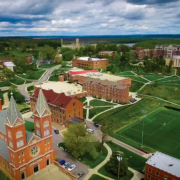
Editor’s Note: The Cardinal Newman Society recently announced Jace Griffith of Idaho Falls High School in Idaho as the winner of the Society’s first annual Essay Scholarship Contest for Catholic college-bound students.  Griffith will receive a $5,000 scholarship toward her education at Benedictine College in Atchison, Kan this fall.  Below is the full text of Griffith’s winning essay.  More information about the Contest can be obtained here.

I was fifteen the first time I attended the Idaho Catholic Youth Conference. Two thousand Catholic teenagers packed into a school auditorium. We were a community of similar age and similar beliefs, and on Friday night we knelt down together to adore one God.

The monstrance moved around the room for an hour in the shaking arms of the priest. His eyes were fixed on his Savior. In the darkness of the room, the illuminated host was the only light.

“Viva Cristo Rey!” came a cry from the back of the room.

Viva!” the congregation replied with one voice. For the first time, I understood that I was not alone as a Catholic youth, and my chest swelled up with fullness.

Growing up in a city where Catholics are a minority, dwarfed in number by “Latter-Day Saints,” has not always been a bad thing. Among Mormon classmates, teachers, and friends, I’ve learned to defend my faith and celebrate its differences. I’ve learned to turn to my Church when lonely. Most of all, I’ve learned that if I do not actively and willingly pursue Catholicism, my life will lack the fullness of God’s truth—and that I want to start that pursuit at a Catholic college. By fostering learning with an emphasis on the development of the whole person and surrounded by a like-minded community, Catholic colleges cater to those who wish to become not only successful in their careers, but also ethical and virtuous men and women with their eyes set on the great fullness that only God can give.

Catholic colleges are known for well-rounded development, encouraging community service, the pursuit of knowledge outside of intended majors, and rigorous academia. Curriculum at many Catholic colleges is centered in the Liberal Arts: this offers students a strong basis for philosophy, religion, literature, languages, history, and the fullness of truth. Not only do students learn the requirements for their majors and minors, they also learn things like why Aristotle is still important today, what exactly Ramadan is, and how many pages of procrastinated literature reading can be crammed into one night. For me, a dedicated daydreamer on track to become a psychologist, I want more from my education than a basic understanding of cognitive development. A Catholic education means psychology would be taught in the context of human dignity and the soul as a part of human health—and as I learn, I’ll be practicing those beliefs in the community through service projects and prayer alongside my classmates.

The benefits of Catholic colleges don’t end with the unique curriculum: Catholic colleges bring together young adults with similar goals and morals. Catholic colleges allow young adults to grow in their faith surrounded by people who are unlikely to criticize or misunderstand them for it. Instead, Catholic, Christian, and undecided students can find encouragement and community support in a mutually cooperative environment. Having spent most of my life with few fellow Catholics in my school, sports, and extra-curricular activities, I am ready to continue my development alongside hundreds of others with the same idea. After all, I’ve spent enough time struggling to explain why I’m skipping school for “a good Friday” and fending off tissues from well-meaning classmates who noticed the ash smudge on my forehead. I want to feel what I felt at ICYC when I was fifteen: fullness! Love and acceptance, strength in my community, and pride in my faith. I want to see that my faith is alive, and that it is alive in the people around me, each of us pushing and pulling each other on a stumbling path toward Heaven.

Impressed by the unique academics and enamored with communities full of the vibrant, persistent, delighted love of Christ, I trust that faithful Catholic colleges will continue to teach their students the fullness that is real truth and real joy. I’ve decided I want God to be the center of my life. In the end, it only makes sense to choose a college that wants the same thing.

Newman Society Celebrates 10 Years of ‘The Newman Guide’ with 2017-18 Release

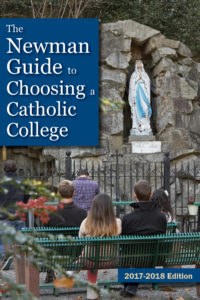
Today, The Cardinal Newman Society releases the 2017-18 edition of The Newman Guide to Choosing a Catholic College and celebrates 10 years of connecting families with faithful Catholic education through the Guide.

The Newman Guide recommends 29 Catholic college, universities, and higher education institutes for their faithful Catholic identity.

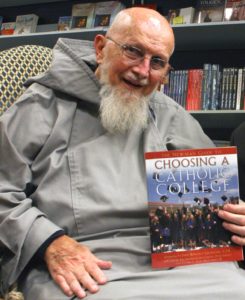
The late Father Benedict Groeschel, CFR, who wrote the preface to the first Newman Guide a decade ago, said it was the Newman Society’s “most important contribution to Catholic higher education ever.”

Since the first edition of The Newman Guide in 2007, the Newman Society has greatly expanded the profiles of the recommended colleges online at TheNewman Guide.com, distributed more than 100,000 free copies of the companion magazine My Future, My Faith, and launched the innovative Recruit Me! program to introduce families to colleges that truly form young people according to the mission of Catholic education.

“In the last 10 years, the institutions recommended in The Newman Guide have experienced remarkable success while remaining committed to a strong Catholic identity,” said Cardinal Newman Society President Patrick Reilly.  “The reputation of and appreciation for these faithful institutions is certainly growing in the Church, and they have become pillars of the New Evangelization in America.”

Exciting Updates at U.S. Residential Newman Guide Colleges:

Ave Maria University (FL)

In seven years, undergrad enrollment climbed 75%. Recent expansions include Catholic teacher formation and the Mother Teresa Project with the Missionaries of Charity to promote service.

Belmont Abbey College (NC)

Undergrad enrollment has grown 70% in five years. An innovator in reducing college costs, the College reset tuition in 2013 (and it’s still the same) and offers a three-year degree program.

Benedictine College (KS)

Benedictine has had 19 straight years of enrollment growth—43% in the last seven years—and 10 new residence halls in a decade. Daily Mass attendance has increased to about 625 students.

Catholic University of America (DC)

The largest of the Newman Guide’s U.S. colleges, CUA added the faithfully Catholic Busch School of Business and Economics to its 12 schools and hosted Pope Benedict and Pope Francis.

Christendom College (VA)

Enrollment is the largest ever at 477, and the College is building a magnificent new Christ the King Chapel and a $13.5 million endowment as part of its $40 million capital campaign.

DeSales University (PA)

Undergraduate enrollment jumped this year and has seen a total 8% increase over seven years. The University has earned a reputation in the arts, including its annual Shakespeare festival.

Franciscan University of Steubenville (OH)

The University known for its vibrant campus spirituality is expanding rapidly into online education. Two-thirds of the students are in Catholic “households,” and half study abroad.

John Paul the Great Catholic University (CA)

Undergrad enrollment at JPCatholic has more than doubled in seven years. At the rapidly growing Escondido campus, students earn bachelor’s degrees in just three years.

Mount St. Mary’s University (MD)

Despite a brief, rocky tenure with a mismatched president, the Mount’s now doing great—a testament to its firm Catholic foundation—under West Point’s former academic dean.

Northeast Catholic College (NH)

Undergrad enrollment has grown nearly 40% in seven years, with five new majors. The new “Arts of the Beautiful” program integrates music, visual arts and aesthetics.

St. Gregory’s University (OK)

Undergrads increased 15% in five years, with exponential growth in the new nursing program. A new initiative focuses on “seamless education” from the liberal arts to career preparation.

Thomas Aquinas College (CA)

Enrollment is the highest ever at 389, and TAC expects to open a new Massachusetts campus in 2018. TAC is top-ranked and second only to Princeton University for alumni loyalty.

Thomas More College of Liberal Arts (NH)

Enrollment grew 10% in the last year, the seventh straight year of growth. The College added Spanish internships and a Poland pilgrimage to its Rome and Oxford programs.

University of Dallas (TX)

Undergrad enrollment has grown 8% in the last seven years. Dallas recently built a new business school center and launched a Catholic teacher certification program.

University of Mary (ND)

The recent addition to the Newman Guide is rapidly increasing its Catholic student enrollment and led this year’s March for Life with seven busloads traveling more than 24 hours.

University of St. Thomas (TX)

Hitting its largest undergraduate enrollment this year in nearly a decade, the University’s percentage of students living in campus residences has increased from 20 to 50 percent.

Walsh University (OH)

The second-largest Newman Guide U.S. college has added six new majors for a total of 70. The University was able to decrease its net price while offering substantial student aid.

Wyoming Catholic College (WY)

Enrollment has grown 150% in seven years with the largest freshman classes in the last two years. The College’s former academic dean was recently appointed president.

# # #

Founded in 1993, the mission of The Cardinal Newman Society is to promote and defend faithful Catholic education.  The Society is a 501(c)(3) tax-exempt, nonprofit organization supported by individuals, businesses, and foundations.

To schedule an interview with the Newman Society, please contact Kelly Salomon, managing editor of The Newman Guide, at ksalomon@cardinalnewmansociety.org.

Nashville Dominicans Turn Focus Entirely to Teacher Formation

A few years ago, Sister Mary Sarah Galbraith, OP, and her team at Nashville’s Aquinas College set out to build a four-year, traditional college by expanding disciplines beyond nursing and education and building a residential campus.

In many respects, they found significant success, and their accomplishments suggest real opportunities for colleges that strongly embrace their Catholic identity.

Now the college has a new vision — still firmly Catholic and promising the bear much fruit for the Church and the New Evangelization. Today the college’s owners, the Dominican Sisters of St. Cecilia, announced a bold new direction that focuses entirely on teacher education and Catholic schools initiatives, while retaining courses in theology and philosophy.

The shift was made partly because of financial concerns, although the college remains strong relative to many other small colleges.

I spoke to Sister Anne Catherine Burleigh, OP, spokeswoman for the Dominican Sisters of St. Cecilia, about the changes and what they mean for Aquinas College.

Centered on Catholic education

Teacher formation is a natural emphasis for the Nashville congregation, which has taught in Catholic schools since prior to the Civil War. Whereas most women’s religious orders have pulled out of Catholic schools and dwindled in number, the Dominican Sisters of St. Cecilia have expanded into 49 schools in 28 dioceses. They are located in the U.S., Canada, Ireland, Scotland, Italy, the Netherlands and Australia.

In 2013, Bishop Hugh Gilbert of Aberdeen, Scotland, was so enthusiastic in welcoming the largely American sisters to his diocese, he described them as heroes rescuing Catholic schools and Catholic culture.

“I’m old enough to remember Westerns,” Bishop Gilbert said. “And here we are, wagons drawn close, feeling our last days have come and our scalps about to be removed, when — lo and behold — the U.S. 7th Cavalry appears over the hill. Here they are, armed not with carbines but rosaries. And we can breathe again.”

The Congregation of St. Cecilia has grown by more than two thirds since 2000. About 250 of the 300 sisters are active in various apostolates, and the average age of the Sisters is 39.

“God is great,” Sr. Anne Catherine says regarding the 16 to 20 postulants the congregation sees annually.

Aquinas College, fully owned by the congregation, has been a hub for the congregation’s training for both the Sisters and lay Catholic teachers. The college is distinguished by its strong commitment to fidelity and to preparing teachers primarily for Catholic schools.

“The approach to teacher education at Aquinas College is based on the conviction that teaching is more than a career choice,” explains Sr. Mary Sarah in a press release about the reconfiguration. “It is both a gift and a mission.”

In addition to teacher formation, the college will continue its very successful initiatives in education and evangelization. The Center for Catholic Education provides spiritual and professional formation for educators and parents beyond the college, and its annual WISE Conference for Catholic School Educators provides a much-needed emphasis on Catholic identity and mission.

The college’s work in Catholic education “is more needed than ever,” says Sr. Anne Catherine. “It’s something that we do well, and we want to continue to do it well.”

Position of strength

Of course, the dramatic changes bring a lot of pain to this small, close-knit community, which learned today that about 60 faculty members and staff will lose their jobs.

More than half the college’s 257 students also must complete their degrees elsewhere. After this semester, Aquinas College will no longer offer degrees in the arts and sciences, business and nursing. The latter was once a mainstay of the college, but it had already phased out the its two-year associates program in nursing to attract more four-year, full-time students.

In keeping with the Sisters’ deep commitment to the good of their students, Sr. Mary Sarah and the college’s other leaders have worked hard to help students make the most of the situation. Fourteen colleges—including local colleges and some of the faithful Catholic colleges in The Newman Guide—have been lined up to accept Aquinas students with comparable tuition and financial aid.

Still, this was an emotional morning for students and employees learning about the new direction for the first time. College leaders were scheduled to meet with faculty and staff at 9:00 a.m., and students soon afterward. The public learned the news before lunchtime.

Did finances have anything to do with the decision? The Sisters acknowledge that Aquinas was under the same severe difficulties that most small colleges face today, competing with state-funded universities and large institutions with big endowments to support financial aid. Aquinas has just $5 million in endowment funds.

Still, it doesn’t seem that the college’s situation is dire. According to the U.S. Education Department’s financial health ratings released just this week, there are many colleges in much worse straits than Aquinas.

Sr. Anne Catherine explains that by making changes now and avoiding debt, the Sisters can be “proactive” and move the college forward “from a position of strength.” The Sisters’ principled refusal to take on heavy debt is unique among small colleges today — especially those that are rapidly expanding their campuses, as Aquinas planned to do before changing direction today. It had just built a new women’s dorm, completed in 2015.

Acknowledging the pain of displaced students and employees, Sr. Anne Catherine said that the careful financial strategy reflects the Sisters’ commitment to “do what is right and good” for the college community while protecting the college and congregation from “serious financial risk.” For now, the Sisters have concluded that abandoning the vision of a four-year traditional college with residential options and student activities is the prudent path forward.

A model for success

While the Sisters have found the changes financially necessary and have centered on their mission of serving Catholic schools, it shouldn’t be ignored what Aquinas College accomplished in recent years toward its prior goal of building a traditional college with multiple disciplines.

In just a few years, Sister Mary Sarah and the college leadership added new four-year bachelor’s level programs, expanded campus residences and student activities, and attracted faculty like Joseph Pearce, the acclaimed literary expert who has led the college’s Center for Faith and Culture. The acclaimed teacher formation program, which remains, has been valuable to bishops and educators around the U.S. and the globe.

In all of this, Aquinas proudly advertised that “we take our Catholic and Dominican identity seriously.” From renovating chapels to hiring faithful faculty, the college put its commitment into action. And the college’s leaders say that fidelity to Catholic teaching was never a detriment to attracting students and support, but in fact was a key strength.

Paul Downey, director of marketing and communications, told me a few weeks ago, “We think Aquinas is a great case study in how strong Catholic identity isn’t just a good idea from a moral standpoint. It also makes for a stronger institution.”

He said that from fall 2011 to fall 2016 — in just five years — the college posted these impressive results:

  • the portion of students who were Catholic increased from 35 percent to 63 percent, despite the college’s location in an area with only 6 percent Catholic residents;
  • the portion of students from out of state increased from 8 percent of first-time freshmen to 67 percent;
  • the portion of undergraduates who were full-time students increased from 32 percent of undergraduates to 69 percent; and
  • new students interested in non-nursing programs increased from 27 percent to 47 percent.

That’s the sort of growth that would make any faithful Catholic college envious!

It may seem contradictory to focus on these accomplishments, on a day when Aquinas College has narrowed its emphasis to teacher formation and thereby eliminated its non-education programs and its plan to expand residences. But the marked accomplishments that I highlighted don’t fully address the financial realities that the Dominicans and all small colleges face today.

What the accomplishments do demonstrate is that it would be very wrong to assume that the college substantially failed in its efforts in recent years—especially the marketing of the college’s strong Catholic identity. In many respects, the college’s Catholic identity was what allowed it to attract students and faculty, and strong Catholic identity will continue to be key to the college’s success in the future.

I hope that other Catholic college leaders learn from Aquinas College’s steadfast commitment to its Catholic mission, to its sponsoring order’s charism, and to financial prudence.

May God bless the Sisters in their very important and urgently needed work of preparing teachers for faithful Catholic education worldwide. I have no doubt that their fortitude and trust in God will carry them through this next journey.

This article first appeared at The National Catholic Register.
Bishop Flores: What Every Catholic Kid Needs for School

Does “Catholic education” begin in Catholic schools—or is there something more foundational?

Bishop Daniel Flores of Brownsville, Texas, has an intriguing answer.

Last week, in his St. Hildegard Lecture at the University of Mary in Bismarck, North Dakota, Bishop Flores argued that there are “habits of the soul” that, when developed “prior to formal education,” help students become more aware of the relationships among physical and abstract realities and God.

This, he says, prepares a student to study disciplines as varied as “grammar, rhetoric, music, biology, medicine, morality and mystical contemplation.”

I spoke with Bishop Flores following the lecture to discuss the implications for Catholic families and teachers.

Back to the Garden

By encouraging formation that occurs “prior to formal education,” Bishop Flores does not propose some sort of Catholic preschool, although developing good habits in the home and parish at a young age is important.

Instead, by “prior” he means fundamental, a prerequisite for a good education at any age.

In his lecture at the University of Mary, he noted that St. Hildegard of Bingen and other great saints exhibited a “synthetic impulse, by which I mean a purposeful concern for the deeper connections that bind all that exists.” They grasped how things and ideas relate to other parts of reality, the “kinship” and order in God’s creation.

This, argued Bishop Flores, was partly a result of their upbringing within a Catholic culture and worldview.

For St. Hildegard, the synthetic impulse was “fertile ground” to produce impressive writings, musical compositions, poetry, moral teaching and scientific studies without ever having the sort of formal schooling that is common to most great thinkers. She had a mind “like Jacob’s ladder,” said Bishop Flores, that ascended to the sublime and descended into practical concerns without difficulty.

This sense of both divine purpose and the relatedness of all reality is valuable to learning, Bishop Flores argued. The synthetic impulse enables the student to gain a deeper understanding and appreciation for the world around us.

It is “somewhat natural to human beings” and therefore available to non-Catholics, but for a faithful Catholic, the synthetic impulse:

…becomes robust and fruitful with baptism into the faith; it comes with looking at life and reality from the gut awareness that the source of all that is, is the Good God; this good God loves immensely, and was interested in a garden at creation, not a wild and chaotic forest of beings related only by a competitive need to survive.

He recommended that Catholics spend more time with other people who appreciate the connectedness of all things, especially how humans relate to each other. He mentioned several categories of good company: children, whose thoughts naturally tend to both realism and imagination; the poor, whose dependency makes them appreciate the “reciprocity of human relations;” poets, writers and other artists, whose work is “reflecting the creative act of the WORD;” farmers, who are attuned to the “natural rhythms of nature;” and the saints, because charity is “the gift of knowing how to relate.”

The confidence of Catholics

I explored these themes further with Bishop Flores after the lecture. If the synthetic impulse is foundational to a good education, I wondered, does it suggest particular methods and practices in formal Catholic education, or is it cultivated entirely outside of our schools?

Bishop Flores believes that Catholic educators certainly can help nurture students’ synthetic impulse—“if you don’t have it, you have to develop it,” he said. But the point of his lecture was to suggest that Catholics, because of their faith, culture and worldview, tend to come to school already confident in the relatedness of things, making them well-prepared for learning and discernment.

Catholic educators should ask, he said, “How well habituated is the student body to seeing things as interrelated? How well have they maintained a traditional Catholic sense of the connectedness of reality?”

Where the synthetic impulse is noticeably lacking, a Catholic school can help.

“But it works much better if there is already a foundation in the home,” Bishop Flores said.

I asked whether he thinks that, given the very secular culture in which most Catholic families live today, many homes still provide this foundation for young Catholics?

He acknowledged the “very steep undertow” in our culture, which is highly individualistic. But he said there remain “expressions of very deep Catholic life” in prayer, spirituality, music and the arts. This sets many young people “on the road” to perceiving truth and the relations of things.

As for Catholic schools and colleges, it’s clear that many today have drifted away from the integrated learning and strong core curricula that helped reinforce the synthetic impulse for previous generations of Catholics. In his lecture, Bishop Flores lamented the “intellectual culture of endless disciplines and sub-disciplines happily unconcerned with what a colleague across the campus may be doing or thinking.”

What has been lost, he said, “is the sheer human joy of pursuing the signs of relationality we know are present in things that may at times appear disparate and unrelated.” Young people should wonder about the unity of creation, but academia wants them to analyze facts in isolation.

Still, that’s not the case throughout Catholic education. Bishop Flores said he is “impressed” by some Catholic schools. It “can be a blessing” that smaller schools have limited resources, he said, because teachers and parents have to work together, increasing the cohesiveness of the community.

He experienced that cohesiveness himself when studying at the University of Dallas, a faithful Catholic college. He was also “very impressed” by what he saw last week at the University of Mary.

Bottom line: there’s much to be restored in education, but “Catholic institutions are in the best position to do it.”

Flesh and blood

Earlier I mentioned Bishop Flores’ recommendation that Catholics spend more time with people in whom the synthetic impulse is especially strong. I asked him to relate this to Catholic education—can schools help provide this for students and faculty?

Obviously schools offer the opportunity for adults to engage with children, one of the groups he mentioned. It’s the encounter with children that draws grade school teachers to the profession. But Bishop Flores suggested that college professors are often too isolated in their disciplines and even socially.

“Many theology and philosophy professors, to put it bluntly, need to get out more,” he said.

We discussed the value of older students mixing with younger ones, an aspect of homeschooling that I’ve found particularly healthy for my own kids. Bishop Flores said he encourages high school students to mentor younger ones and develop an ethos of “looking out for each other.”

Catholic education can also introduce students to the poor. But the encounter should be more than “social justice” activities and providing material aid, Bishop Flores suggested. It should help students relate humanly to the people they help by getting to know them.

“The poor are not a category,” he said. “We’ve eclipsed the personal encounter, because we’ve categorized people.”

With regard to experiencing the arts, we talked especially about the Hispanic Catholic culture prevalent in his Brownsville Diocese, with its “very tactile” feasts, processions and devotions. Bishop Flores said these are reminders of early European expressions of Catholic life, like the ornate Polish churches he explored as a youth, which can be “extremely powerful” in transmitting the faith and encouraging wonder.

“The Church needs to recapture some of the ethnic beauty of the Church,” he said.

And students should be introduced to the saints, especially by the display of relics. Bishop Flores finds that young people “are the most responsive” to such tangible displays of both divine and material reality.

“Christianity becomes an idea until you put some flesh and blood on it,” he said.

True Catholic education

After our conversation, it occurred to me that Bishop Flores’ contemplation of the synthetic impulse is helpful to developing a proper sense of Catholic education.

Instilling good “habits of the soul” in young people prepares them for formal schooling, but it is already part of Catholic education in its own right. Catholic education is not an institution with the label “Catholic.” It is the project of forming young people in the faith for fully human living and to gain the inheritance promised by Christ.

So when Catholic parents and parishes nurture the synthetic impulse by teaching the faith and living Catholic culture, it is as much an exercise of Catholic education as teaching theology in a classroom.

Blessed John Henry Newman said Catholic education should integrate religion and science so as “to reunite things which were in the beginning joined together by God, and have been put asunder by man.” By appreciating “the grandly expressive relation between all things that are,” Bishop Flores added, “a Christian is called by grace to be the mediator of a related world that struggles to live up to its relations.”

Now that sounds like a Catholic education that lives up to its name.

This article first appeared at The National Catholic Register.
One Catholic College Temporarily Closes, But Another Springs Up

In 2008, the cover of Commonweal magazine proclaimed this headline: “Catholic to the Core: How One College Does It.” It celebrated the 10-course, four-year core curriculum and strong commitment to liberal education at Saint Joseph’s College in Rensselaer, Ind.

But last week, Saint Joseph’s announced that it would temporarily shut down its main campus with hopes of erasing its debt and starting over again. According to news reports about the college’s needs, dwindling endowment and inability to turn assets into cash, it seems the college has a very steep climb to get back on its feet—and it’s already facing a possible loss of accreditation.

Coincidentally or providentially, in the very same week, Thomas Aquinas College of Santa Paula, Calif., announced that it would be opening a new campus in Northfield, Mass., in the fall of 2018.

Depending on which model other Catholic colleges choose to follow, last week’s news may be a harbinger of future college closings or a hopeful sign of the renewal of Catholic education.

‘In all things to remain faithful’

Commonweal has never featured Thomas Aquinas College on its cover or even offered faint praise for the college—at least I could find none in its online archives. That’s a shame, because Thomas Aquinas exceeds Saint Joseph’s in its commitment to a strong core curriculum and liberal studies. But there are substantial differences between the institutions that, no doubt, explain the apathy of the “Catholic lite” authors at Commonweal and the excitement among many Catholic parents, priests and bishops about the ascendancy of Thomas Aquinas College.

The college has risen up both the Catholic and the secular rankings as one of the top colleges in the nation. It is highly recommended by National Catholic Register (“producing vocations at a time when vocations from far larger and better known Catholic universities have slowed to a trickle”), The Cardinal Newman Society (“impressive intellectual rigor that is matched by a commitment to orthodox Catholicism”), the American Council of Trustees and Alumni (curriculum is in top 2 percent of U.S. colleges), the Intercollegiate Studies Institute (“one of the strongest curricula in the U.S.”), Princeton Review, U.S. News and World ReportKiplinger’s “Best Values in Private Colleges” and more.

But the real selling point about Thomas Aquinas College is its alumni, who bear all the marks of highly educated, highly capable and devotedly Catholic young men and women. Thomas Aquinas is second only to Princeton University for alumni satisfaction as measured by annual giving.

It’s incredible and contradicts all the secular “wisdom” that a staunchly faithful Catholic institution, unreservedly committed to the true Faith and to a pure liberal arts curriculum, can survive and even thrive in today’s American culture. But we see other confidently Catholic colleges in The Newman Guide doing well also. That bodes well for Catholic families.

Thomas Aquinas College embraces a strongly Catholic identity that is rooted in the firm conviction that the Catholic Faith is revealed truth and therefore foundational to higher studies. This carries through the curriculum, the residence halls, and the frequent activity at the stunningly beautiful campus chapel.

According to the college:

At Thomas Aquinas College, the Catholic faith is more than a mere adornment on an otherwise secular education. The intellectual tradition and moral teachings of the Catholic Church infuse the whole life of the College, illuminating all learning as well as the community within which learning takes place. The curriculum is ordered toward theology — that is, the knowledge of God — and the College strives in all things to remain faithful to the Magisterium of the Catholic Church.

Reinventing a college

That’s simply not the way Saint Joseph’s has chosen to market itself. Relative to other Catholic colleges, Saint Joseph’s has demonstrated pride in its history as a missionary school for Native Americans and has taken steps to preserve its Catholic identity. And yet, there is something clearly different implied in the college’s appeal to “Gospel values” and “Christian humanism” than the integrated Catholic culture that Thomas Aquinas College embraces without reserve. Although Saint Joseph’s has held on to its strong core of liberal studies, I don’t believe that it could claim a program of Catholic formation and a curriculum and campus life that exude certainty that our Catholic Faith is where we meet the very source of knowledge and truth.

Cardinal Raymond Burke, when visiting Thomas Aquinas College, described the students as showing “a deep love of Christ, God Incarnate, and of His Church.” Most college admissions directors would say that doesn’t “sell” today. But Thomas Aquinas and other colleges are doing it. The waiting list is large enough to warrant a new east coast campus.

No doubt the editors of Commonweal would cringe at what might be perceived as a closed, non-diverse community at Thomas Aquinas. That’s one way to see it, although I think they’d find more diversity among the students than they assume, and it’s impossible not to be drawn to the beauty of Catholicism as soon as one steps onto the Santa Paula campus. Saint Joseph’s still has much of this also, especially with its large iconic chapel, although its presence seems more a tribute to the past than to a vibrant, living Catholic culture.

What I see at places like Thomas Aquinas College is a joyful, unapologetic embrace of our Catholic Faith as the door that opens our minds to true wisdom and virtue. If the purpose of a college is to teach and seek truth, then nothing Catholic—not our beliefs, ethics, practices or traditions—should be regarded as anti-intellectual or otherwise opposed to the work of the academy.

And so I question the exaggeration of another media headline: “Can a Small College Close to Reinvent Itself?” from the Chronicle of Higher Education last week. It detailed the efforts to save Saint Joseph’s by, it appears, primarily cutting programs and faculty to address its financial woes. Nothing is mentioned about emphasizing the college’s obvious market niche to recruit new students—its core curriculum and its Catholic identity. It won’t surprise me if the core curriculum goes away entirely in the new Saint Joseph’s College, if it manages to reopen.

From my perspective—after 25 years of urging Catholic higher education leaders to renew Catholic identity in fidelity and joyful service to the Church—that’s not “reinventing” a Catholic college at all. It’s tinkering with an old house that was long ago condemned by the higher education elite, which now dominates the surrounding community and has rezoned it for purposes that a small Catholic college can never fulfill. If Catholic colleges today want to compete in the same market as public universities and secular elite institutions, they’ll most likely close before long.

What might have been?

I can’t say that’s the primary reason Saint Joseph’s failed—especially since it held on to its Catholic identity better than many others—but a new, exciting embrace of the college’s roots might have helped bring students in. A cursory review of the college’s website reveals a Catholic baseline but little that would be especially attractive to someone seeking a faithful Catholic education. The college has no theology department, just majors combining philosophy and broad religious studies and a graduate program for lay ministers sponsored by the Diocese of Lafayette. Its campus ministry offers a daily Mass and a couple on Sundays, confessions, liturgical activities and Taize prayer. It sponsors a large number of service activities—which are important but found at most secular colleges today—and a pro-life club and LGBT “safe zone” training. Other campus clubs include the Spectrum Alliance for “people who fall anywhere on the spectrum of gender identities and sexual orientation.” Residence halls are mostly single-sex, a rare blessing even in Catholic colleges today.

Who knows what might have been, had Saint Joseph’s decided to fully embrace the model of Thomas Aquinas College? I doubt we’ll get a chance to see. But other colleges could get ahead of their debt and give it a try.

I think it’s certain that a small Catholic college that sees its identity as something of an historical note, recalling a Catholic culture that has disappeared, will not successfully compete with secular private and public higher education. But a college that restores Catholic culture—that lives it today and immerses its students in the beauty and wisdom of the Catholic tradition—will be blessed, I believe.

It’s exciting to see the new efforts like Pontifex University, a Catholic graduate arts school, and Our Lady Seat of Wisdom, a Canadian college that just got approval for a three-year bachelor’s degree. And there are many others in The Newman Guide that are growing with the support of Catholic families and increasing awareness of these faithful college options.

Thank you to all of these colleges for giving Catholic parents hope. Let’s pray for them, as it’s a difficult time for all small colleges, to be sure.

This article first appeared at The National Catholic Register.

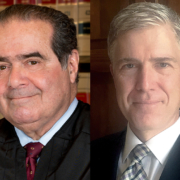
Scalia and Gorsuch: Both Lamented ‘Liberalism’ in Catholic Education

When President Donald Trump said he would nominate a Supreme Court justice in the mold of Justice Antonin Scalia, who died one year ago on Feb. 13, everyone knew that meant someone who shares Scalia’s originalist philosophy of constitutional law.

But who expected that the appointee, Neil Gorsuch, would be another Georgetown graduate? And one who apparently once shared the late Catholic jurist’s disapproval of “liberal” trends in Catholic education?

To be precise, Scalia graduated from the Jesuits’ Georgetown University in 1957, and Gorsuch graduated from Georgetown Preparatory School in 1985. But years earlier, both institutions sprang from the same Georgetown College that Father John Carroll (the future archbishop of Baltimore) founded in 1789. In fact, there was little distinction between the secondary school and the college for nearly a century. The Preparatory School finally separated and moved from Washington, D.C., to its present location in Bethesda, Maryland, in 1919.

‘Not Catholic Anymore’

When Father Carroll founded Georgetown, it was with great hope that the school would help firmly establish the Catholic Faith in America.

“The object nearest my heart now, and the only one that can give consistency to our religious views in this country, is the establishment of a school, and afterwards a Seminary for young clergymen,” he wrote in 1785 to Father Charles Plowden in England.

A historian at Georgetown Prep, Steve Ochs, has written that the College once embraced the traditional view of Catholic education—that its aim is to form young people in Christ and for Christ: “Most importantly, the Jesuits of Georgetown regarded the Christian formation of students as their primary mission. Knowledge and skills, although important, were approached as a means to an end: the knowledge and love of God.”

The University today, sadly, no longer has this view of education. This is most apparent in the dossier on Georgetown scandals that accompanied the late William Peter Blatty’s petition to the Vatican.

In 2014, Justice Scalia famously declared that “Georgetown University is not Catholic anymore.” In his days at Georgetown, Scalia said, “they rolled you out of bed to attend Mass. Not anymore.”

According to The Remnant:

One little vignette still fondly remembered by the Justice harks back to what Georgetown was.

At his final oral exam prior to receiving his degree (History), Scalia was breezing along when Dr. Wilkinson, the chairman of the department who presided over the three professor panel, asked this question: What was the most important event in the history of the world?

The confident candidate thought, “I have done very well up to here and there is no wrong answer to this one,” but as he responded Prof. Wilkinson continued to shake his head signaling that the student had it all wrong. Was it the Battle of Waterloo, or the Greek valor at Thermopylae? The panel member remained unimpressed with the candidate’s answers.

Finally, Dr. Wilkinson replied: “Mr. Scalia it was the Incarnation, when Christ became a man that is the correct answer.” One seriously doubts that Dr. Wilkinson’s question is ever asked at Georgetown examinations today, and if it were, clearly his response would no longer be considered correct. Despite his answer, Antonin Scalia graduated from Georgetown U. summa cum laude, no mean feat in those days in which grades were not “curved,” and no one had ever heard of “grade inflation.”

The prior year, Scalia addressed Catholic students at the University of Virginia and also criticized Georgetown University:

“When I was at Georgetown, it was a very Catholic place. It’s not anymore—and that’s too bad,” Scalia said. “What has happened to Catholic universities, that they would lose their reason for being?”

He said the Catholic Church as a whole “has been in trouble for a while,” having lost some of its zeal for evangelization, for which Catholic education is the Church’s primary tool.

Need for Moral Formation

Justice Scalia didn’t come to that view toward the end of his life; he had deep concern for Georgetown and Catholic education generally for many years. In 1997, Scalia addressed The Cardinal Newman Society’s national conference in Washington, D.C., and he urged Catholic colleges to hold on to their Catholic beliefs:

The American landscape is strewn with colleges and universities, many of them the finest academically in the land, that were once denominational, but in principle or practice no longer are. With foolish sectarian pride I thought that could never happen to Catholic institutions. Of course I was wrong. We started later, but we are on the same road.

Scalia believed strongly in the continued need for Catholic education in today’s society, “because of the moral environment in which its work is conducted—an environment that sternly disapproves what the Church teaches, and in most cases what traditional Christianity has always taught, to be sinful.”

For that reason, the Catholic college must not shy away from “moral formation,” he said. “Catholic universities cannot avoid that task, and indeed betray the expectations of tuition-paying Catholic parents if they shirk it,” he argued.

Again in 2011, in a speech given at Duquesne University School of Law, Scalia adviocated moral formation:

Our educational establishment these days, while so tolerant of and even insistent on diversity in all other aspects of life, seems bent on eliminating the diversity of moral judgment, particularly moral judgment based on religious views. I hope this place will not yield, as some Catholic institutions have, to this politically correct insistence upon suppressing moral judgment, to this distorted view of what diversity in America means.

Scalia told the audience that moral formation “has nothing to do with making students better lawyers, but everything to do with making them better men and women. … Moral formation is a respectable goal for any educational institution, even a law school.”

He added, “A Catholic law school should be a place where it is clear, though perhaps unspoken, that the here-and-now is less important, when all is said and done, than the hereafter.”

An Episcopalian Conservative

Scalia’s high school experience, like his experience of 1950s Georgetown, was very good. He said that he became a “serious Catholic” at the Jesuit Xavier High School in New York, because of the “thoroughly religious atmosphere of the school.”

Gorsuch also attended a Jesuit high school, and like Scalia, he was a successful student. Scalia graduated in 1953 as valedictorian and first in his class at Xavier. Three decades later, Gorsuch was a top debater and was elected student body president at Georgetown Prep.

Both were fiercely conservative even as young men. “This kid was a conservative when he was 17 years old,” said Scalia’s classmate and future New York State official William Stern. “An archconservative Catholic. He could have been a member of the Curia. He was the top student in the class. He was brilliant, way above everybody else.”

Gorsuch, too, was openly conservative, but he found himself in a different environment than the “thoroughly religious” Xavier that Scalia attended. According to the Jesuit America magazine, Gorsuch sparred with both political and theological liberals at Georgetown Prep, even though he was an Episcopalian:

As a student at the tony, Jesuit-run Georgetown Preparatory School, Neil Gorsuch, the son of a Reagan administration official, was known as something of a conservative firebrand among the mostly center-left student body and faculty.

In the 1980s, students at the D.C.-area boarding school spent the minutes before student government meetings hashing out the political debates of the day.

Mr. Gorsuch, who was nominated on Jan. 31 to the Supreme Court by President Donald J. Trump, participated in the informal debates, where he was routinely teased, accused of being “a conservative fascist.” No shrinking violet, he would shoot back, taking on the liberal ethos of the school and even arguing with religion teachers about the liberal theological trends in vogue at the time.

Nevertheless, America reports, Gorsuch was popular and appears to have had a sense of humor, which was the cause of a recent flurry of news reports claiming that President Trump’s Supreme Court nominee had founded and led a “Fascism Forever” club in high school.

Ochs, the historian who teaches at Georgetown Prep and remembers Gorsuch from years ago, explained to America that the club was “a total joke.” Among the activities that Gorsuch listed in his high school yearbook, he identified himself as “Founder and President” of the “Fascism Forever Club.” (He also claimed to be a “Lousy Spanish Student” and president of the “Committee to reform The Beast.”)

“There was no club at a Jesuit school about young fascists,” Ochs told America. “The students would create fictitious clubs; they would have fictitious activities. They were all inside jokes on their senior pages.”

But it was not all fun at the liberal Jesuit school, apparently.

“There were some teachers who were ultra-liberal, and he would spar with them in class, like in religion class specifically, I remember, but always in good nature,” Ochs told America.

Distinguished Alumni

There’s been no sparring with Georgetown Prep this year over its graduate’s nomination to the Supreme Court.

“We are proud to have a son of Georgetown Preparatory School, a Catholic, Jesuit school founded the same year the United States Supreme Court was established, nominated to the nation’s highest court,” said Father Scott R. Pilarz, S.J., the school’s president, in a public statement. “All of us at Prep send our prayers and best wishes.”

America also reports that 70 of Gorsuch’s 90 classmates wrote a letter to Senators urging his confirmation.

If their wish is granted, Gorsuch is widely expected to be a strong advocate on the Court for religious freedom and the protection of human life from abortion and physician-assisted suicide.

When accepting his nomination, Crux reports that Gorsuch thanked his “friends, family and faith” for keeping his feet on the ground.

This article first appeared at The National Catholic Register.

CNS Joins Amicus Brief Upholding ERISA Church Plan Exemption – Advocate Health v Stapleton, U.S. Supreme Court

Click here to read.

‘Exorcist’ Author’s Canon Law Case Against Georgetown Continues

William Peter Blatty, best-selling author and Academy Award-winning screenwriter of The Exorcist, died Thursday at the age of 89 after battling a form of blood cancer. But his final work is still underway: a petition to the Vatican, seeking the enforcement of canon law to reform Georgetown University’s Catholic identity, is still in front of the Church’s highest court.

Although Bill Blatty is appreciated widely for his writing talent, great humor and one of the scariest movies ever made, we should also remember him as a faithful Catholic and a passionate advocate for Catholic education.

In many of his works, Blatty explored the depths of good and evil, psychology, theology and spirituality with great respect for his subject matter. And as he explained often, his objective was never “horror.” His was an inspiring human quest to catch a glimpse of God amid extraordinary experiences that test the soul.

In his last years, Blatty’s appeal to the Vatican to correct Georgetown’s wrongs demonstrated that his Catholic faith remained strong, as did his deep concern and love for the sincerely Catholic university that he attended in the 1940s.

Petition at Vatican

Manuel Miranda, a Georgetown alumnus who helped Blatty organize the petition, told me Monday that Blatty made arrangements before his death to keep the Vatican petition alive.

Blatty named Miranda his “alternate” in the canon law case. Miranda, a former president of The Cardinal Newman Society, served as Blatty’s legal counsel and helped him found the Father King Society of concerned Georgetown alumni, students, parents and faculty members. The case has worked its way through the Catholic hierarchy to the Vatican’s highest court, the Supreme Tribunal of the Apostolic Signatura, and the King Society’s canon lawyer will meet with the Signatura about the petition this week.

In May 2012, Blatty wrote a letter urging friends of Georgetown to join his canon law petition. “For 21 years now, Georgetown University has refused to comply with Ex corde Ecclesiae (“From the Heart of the Church”), and, therefore, with canon law,” Blatty wrote. “And, it seems as if every month GU gives another scandal to the faithful!”

The petition, which Blatty began thinking about filing a few years prior, was announced on the heels of Georgetown’s announcement that HHS Secretary Kathleen Sebelius was invited to speak at the university’s 2012 commencement. Sebelius, a Catholic, had expressed public support for abortion and led the implementation of the HHS contraception mandate. The mandate — which is still being fought in the courts — threatens the religious freedom of Catholic institutions and had been vigorously opposed by the U.S. bishops in numerous public statements before Georgetown invited Sebelius to campus.

At Blatty’s request, the Newman Society produced a dossier documenting the numerous Catholic identity abuses at Georgetown. Many but not all of these abuses have been reported, but the full dossier and petition have not yet been made public.

“Each of these scandals is proof of Georgetown’s non-compliance with Ex corde Ecclesiae and canon law,” Blatty wrote in 2012. “They are each inconsistent with a Catholic identity, and we all know it. A university in solidarity with the Church would not do these prideful things that do so much harm to our communion.”

In May 2013, the petition was submitted to Cardinal Donald Wuerl of the Archdiocese of Washington with the support of more than 1,200 “alumni, students, parents, teachers, and other laity from around the world.”

“After one year of work, the petition we submit today is 198 pages, 476 footnotes, 91 appendices, 124 witness statements, a commissioned 120-page institutional audit of Georgetown, a sworn certification of facts, and a legal opinion,” Miranda announced. “We have documented 23 years of scandals and dissidence, over 100 scandals in the most recent years alone.”

The Archdiocese of Washington advised that the petition be sent to the Vatican, and in October 2013, Blatty announced that the case was submitted to several dicasteries in Rome. The petition then had 2,000 supporters.

“What is profoundly interesting is that the very first remedy that we asked of the Archbishop of Washington, His Eminence, Donald Cardinal Wuerl, was: ‘If the Holy Spirit leads you to it and your conscience will allow it, to declare publicly that Georgetown University is compliant with Ex corde Ecclesiae, orients its institutional initiatives according to standards that are consistent with the norms and morality of the Church, and lives up to the title ‘Catholic,’” Blatty said in a statement at the time. “His Eminence opted not to do that.”

Impact uncertain

On April 4, 2014, Blatty received a response to the canon law petition from Archbishop Angelo Zani, secretary of the Vatican’s Congregation for Catholic Education. “Your communications to this Dicastery in the matter of Georgetown University. . . constitutes a well-founded complaint,” wrote Archbishop Zani. He added, “Our Congregation is taking the issue seriously, and is cooperating with the Society of Jesus in this regard.”

The petition has since been appealed to the Apostolic Signatura. It is not clear what communications have resulted between the Vatican and Georgetown University, but the Catholic identity abuses at Georgetown have continued with no indication that administrators will conform with Ex corde Ecclesiae.

Last March, for example, the Archdiocese of Washington chastised the university for hosting Planned Parenthood CEO Cecile Richards on campus — a woman responsible for the deaths of almost three million babies. The Archdiocese said Georgetown lacks an “environment of morality, ethics and human decency” on campus, and the archdiocesan newspaper went even further in denouncing the decision.

“Welcoming an ardent supporter of the violent taking of an unborn human life is deeply offensive and heart-rending to other Georgetown students, teachers, alumni and community members who believe in the Catholic teaching that all human life has God-given dignity from conception to natural death,” the paper stated in an editorial. “Apparently to some, the one group of people that it is acceptable to offend, even at a Catholic university, are Catholics.”

Richards used her platform at Georgetown to rally support for Planned Parenthood and the moral evils of abortion and contraception, potentially endangering students’ souls according to the Newman Society, which called on Georgetown to rescind the invitation. 

Unfazed by criticism about giving a platform to America’s top abortion activist, Georgetown hosted a day-long strategy session for abortion activists in November 2016 who gathered to discuss the “injustices” of legal barriers to abortion. The event was capped off by a presentation meant to gather support for legislation that would force taxpayers to pay for abortions.

‘Our only recourse’

The scandals at Georgetown were heartbreaking to Blatty, who attended Georgetown on a full scholarship and had great respect for the Jesuits of his day. Matt Archbold wrote in 2013, “Blatty’s love of Georgetown runs deep and back to the time when he attended the Jesuit university. Georgetown wasn’t just the setting for the book and the classic film. ‘The film is in many ways a hymn to Georgetown,’ William Friedkin, the film’s director, recently told USA Today in an interview with him and Blatty to mark the film’s upcoming 40th anniversary.”

The canon law petition was not intended to punish Georgetown for its swing away from a once-strong Catholic identity, but instead Blatty wanted to spark reform.

“I believe [a canon law petition] is the only thing that can stop Georgetown in its path,” Blatty told The Cardinal Newman Society in a May 2012 interview. “Only firm Church action can save it and make it a great university. It is our only recourse. Our only hope.

“And not just at Georgetown,” he said. “I hope alumni from other colleges will contact me for help in submitting petitions regarding their colleges. I hope that Georgetown will see the light and alter its course.”

William Peter Blatty, requiescat in pace. It now remains for other good Catholics to continue your noble effort.

Newman Society Editor Adam Cassandra contributed substantially to writing this report.

This article first appeared at The National Catholic Register.

CNS Joins Amicus Brief Opposing Redefinition of Sex in Title IX – Gloucester County School Boad v G.G., U.S. Supreme Court

Click here to read.

Father Scanlan Was America’s Pastor to Catholic Higher Education

Father Michael Scanlan, T.O.R., who died Saturday, reformed Franciscan University of Steubenville and built it into one of America’s most faithful and vibrant centers of Catholic learning. He is rightly acknowledged as a foremost leader in the renewal of Catholic higher education.

More than that, I think it is fitting that he be remembered as America’s devoted pastor of Catholic higher education in the 20th century.

Why do I call him pastor, and not first president or leader or reformer? Because what I hear most from nearly everyone who knew him, is that he touched them personally and cared deeply for the souls he encountered, bringing them closer to Christ. That seems to be the heart of his success and his motivation.

Thousands of his students, faculty, staff, trustees and others who knew him would doubtless agree.

Also, by his priestly witness Father Scanlan was in effect a shepherd to all Catholic colleges and universities, helping launch the renewal of faithful higher education and setting an important example for other college leaders to follow.

He was, of course, not the only major figure in Catholic higher education in the last century or president of the largest Catholic university. But Father Scanlan deserves the accolade nonetheless—surely more than his early contemporary Father Theodore Hesburgh, who accumulated popularity, prestige and influence but led the University of Notre Dame (and probably many individual Catholics) down a path that ends tragically in relativism and secularism.

When Father Scanlan became Franciscan University’s president in 1974, most American colleges founded by Catholic religious orders were rapidly shedding their distinctive identity. Faithful laymen responded by founding Thomas Aquinas College, Magdalen College, Christendom College and Thomas More College of Liberal Arts. But there was something unique happening at Franciscan University: a saintly Franciscan friar was again answering God’s call to “rebuild my Church.”

By the influence of Franciscan’s graduates, Father Scanlan continues to do just that. And the Church should be very grateful.

University reformer

I have long admired Father Scanlan and met him on several occasions. But after his death, dwelling upon his life and impact, I was eager to know more about those first exciting years when he began to transform what was then called the College of Steubenville.

So I spoke by phone with Dr. Alan Schreck, chairman of Franciscan University’s theology department for about 14 years under Father Scanlan. He gave a moving account of the incredible work and vision of this giant of Catholic education.

While still a student in college, Dr. Schreck first met Father Scanlan shortly after he was asked by the college’s trustees to consider putting his name in for the presidency. Father asked the young theology student for prayers that he make the right decision. That greatly impressed Schreck, as did Father’s vision.

“I will be president only if they allow me to make Jesus Christ lord of every aspect of the college,” Dr. Schreck remembers him saying.

At the time, Father Scanlan was rector of the Franciscan seminary in Loretto, Penn., and a well-known figure in the Catholic charismatic renewal. He had a worldwide following. My father-in-law, who lived in the Philippines until the 1980s and was very active in charismatic prayer groups and conferences, impressed me with his memories and great fondness for Father Scanlan.

I have often wondered how difficult it must have been for Father Scanlan to pull back from his charismatic ministry to take up a college presidency. But Dr. Schreck says that’s not what happened: Father had an “incredible capacity for work” and served on the Catholic renewal’s national committee and as pastor for a local parish established for charismatic Catholics, even while serving as college president.

Today the charismatic influence of Father Scanlan is still apparent at Franciscan University, although it has never been an official characteristic of the institution. It certainly contributed to the college’s reform and growth, attracting Catholics who are on fire with love for Christ. For Father Scanlan, it was “just a dimension of being Catholic,” Dr. Schreck explains. Father’s primary concern for the college and its faculty members was that they be faithful to the Magisterium, which is why he required the oath of fidelity for professors.

While the changes drove away some administrators and teachers, they also attracted a variety of notable scholars. They were attracted to Father Scanlan’s “integrated vision,” says Dr. Schreck. This called for 1) “dynamic orthodoxy,” ensuring that faculty are “loyally Catholic” while “teaching in such a way that theology is alive and life-giving;” 2) student life “where students could grow humanly as well as academically;” and 3) stronger academic quality.

I think that Father Scanlan’s academic priorities are largely overlooked today, given his reputation as a spiritual guide and preacher. But Dr. Schreck says Father immediately insisted on hiring Ph.D.’s, a step above many other Catholic colleges that, in those days, frequently hired master’s level professors.

With the conviction that theology is “queen of the sciences,” Father insisted that Franciscan have a full department of theology. The College of Steubenville had only a few core theology courses in 1974, but no major. Dr. Schreck later worked with Father to hire stars like Dr. Scott Hahn, Father Francis Martin and Dr. Regis Martin, as well as philosopher Dr. John Crosby.

With regard to student life, Father Scanlan wanted to ensure full integration between the students’ studies, especially in theology, and their campus experience. He instituted “households,” small communities of students who pray together and support each other in their daily lives. Noticing that students tended to go to Mass on Saturday evening before partying, Father preached at Sunday Mass and gradually drew students in. Campus ministry was fully devoted to “preaching of the Gospel.”

All of this made Franciscan University the shining model on a hill that it is today. Other Catholic colleges have followed the example, each in their own way, once again building up faithful Catholic education in many states across the country.

Extraordinary leader

Brian Scarnecchia, who taught legal studies at Franciscan University for 20 years and is now an associate professor at Ave Maria School of Law, also has known Father Scanlan since the 1970s. He tells an amazing story of Father Scanlan before he became president—in the 1960s, when Father was a theology professor and honors dean at the college.

Rev. Martin Luther King, Jr., was killed in Memphis in the summer of 1968, and Steubenville was on the verge of a race riot. Because of the city’s great respect for Father Scanlan, the mayor took the extraordinary step of turning the city government over to him. Father’s tactic of placing one black and one white police officer in every police cruiser helped avoid a riot and likely saved the city from burning.

Scarnecchia also recalls when Father and Bishop Albert Ottenweller of Steubenville were arrested outside a Youngstown, Ohio, abortion clinic in 1989. Scarnecchia helped spring them and the other “Youngstown 47” from imprisonment at the National Guard Armory.

In court, the judge asked Father if he is familiar with the Bible passage, “Let every person be subordinate to the higher authorities” (Rom. 13:1). Father Scanlan asked whether the judge had heard the passage, “We must obey God rather than men” (Acts 5:29).

That’s not your typical college president.

I heard another tale straight from Father Scanlan a few years ago that, for me, exemplifies Father’s inventiveness, leadership and trust in God that brought him so much success. Unfortunately, I’ve not found a single person who confirms the story, so it will have to be categorized somewhere in the realm of legend.

Here’s what I recall: Father told me that when he became president of the College of Steubenville, the campus was a sore sight. One thing that particularly irked him was the lack of a proper lawn.

“There was no grass,” he said. That might have been a bit of exaggeration, but the college had no money for groundskeeping, and students had trampled much of the grass bare.

With no money, most college leaders would have turned to other problems with apparent solutions. Instead, Father prayed. And the answer he received meant fertilizing the lawn by a creative method that somehow involved the local sanitation authority. (Here’s where I’d love to get some confirmation—today there are all kinds of laws that keep garbage, or sewage, or whatever it was off private property—but that’s how I remember the story.)

In those days, a struggling Ohio college didn’t have central air conditioning. All summer, Father said, faculty and staff were faced with the terrible options of sweltering in hot buildings or opening up the windows. He said the smell was so bad, they chose to swelter.

Then, with that Irish twinkle in his eye, Father said, “But sure enough, we had grass by the time the students arrived in the fall. And we’ve had grass ever since!”

There are, no doubt, many anecdotes revealing Father Scanlan’s great capacity for looking above his challenges to the God Who makes all things right. No doubt this strength came from prayer.

Dr. Schreck recalls that Father would sometimes not get to his office until 11 a.m., because he spent his mornings in prayer.

“I don’t know how to turn this university around,” Father Scanlan admitted. “Only God can do that.”

Leader of the renewal

I asked Dr. Schreck whether Father had ever indicated any angst about leading the reform in Catholic higher education. His work was counter-cultural, and he bucked the secularizing trend among most Catholic colleges. Surely this didn’t please his peers at most other Catholic colleges.

On the other hand, Father Scanlan must have felt the responsibility of setting an example for other college leaders. He must have known that he was being watched, and thankfully he lived to see some of the enormous impact his example had—especially at the growing number of faithful Catholic colleges.

Didn’t the pressure of leading such important reform in the Church ever get to him?

Dr. Schreck doesn’t think so. In fact, he says that Father Scanlan stayed focused on the tasks that God set before him, and he didn’t seem to worry much about the bigger picture.

“If we do well what we’re doing, we will make an impact,” was Father’s outlook.

Father Scanlan did have the conviction that his vision for Franciscan University “was the future of Catholic institutions as they should be,” says Dr. Schreck, and that vision had real influence. He recalls a symposium some years ago following Father’s retirement, when leaders of several Catholic universities came to Franciscan to discuss the mission of Catholic higher education—a sign of their respect for Franciscan’s stature as a leading example of faithful education.

“He really wanted to do God’s will,” says Dr. Schreck. “If that happened, it was the grace of God” that would bring about other changes elsewhere, “as long as we remained faithful to the vision.”

Today Franciscan is pushing forward into online education, an opportunity and challenge that Father Scanlan never faced himself. But Dr. Schreck says the vision remains the same: to find ways to educate well, and to keep it Catholic.

That surely sounds like good counsel for any venture in Catholic education today. It would have met with much skepticism in the 1970s, when the very possibility of a Catholic college was being questioned. Today, we know for certain that Catholic education can be done well—and can be thoroughly Catholic—because of Father Scanlan’s extraordinary example.

He did what he set out to do: he made Jesus Christ lord of every aspect of his college, and of his life.

May God have mercy on Father Michael Scanlan’s soul and take him into His loving arms.

This article was originally published by National Catholic Register.